
Last updated September 16, 2026
The Complete Guide to Insulation in Costa Mesa
Costa Mesa averages only 6 nights below 40°F per year, so most homeowners assume insulation is somebody else’s problem. Wrong. In our 15 years working on Costa Mesa homes, we’ve learned that improperly insulated houses here run their AC 40% more than necessary because marine air infiltration, not temperature swings, is the real performance killer. This guide explains why coastal humidity, attic radiant heat, and disconnected insulation systems cost you money year-round, and exactly what to do about it. By the end, you’ll know which insulation types work in Costa Mesa’s specific climate, what moisture risks to avoid, what rebates you’re leaving on the table, and when to call a specialist instead of guessing. For DIY vs Professional Insulation: The Costa Mesa Homeowner’s Decision Guide, see our companion post.
Quick Answer
Insulation in Costa Mesa is primarily a moisture-control and cooling-load problem, not a heating problem. The most effective setup for most local homes combines air sealing with moisture-resistant attic insulation (blown-in fiberglass or cellulose), a radiant barrier to block attic heat, and crawl space encapsulation to stop humid ocean air from entering the building envelope. A properly insulated Costa Mesa home typically sees 20-35% lower cooling costs and noticeably more even room temperatures.
Table of Contents
- Why Costa Mesa’s Climate Changes the Insulation Rules
- The Right Insulation Types for Costa Mesa Homes
- Attic Radiant Heat: Costa Mesa’s #1 Comfort Complaint
- Moisture, Mold, and the Marine Layer Problem
- Crawl Space Insulation in a Coastal Climate
- Air Sealing: The Step Everyone Skips
- SoCalGas and SCE Rebates Costa Mesa Homeowners Miss
- Why Attic, Walls, and Crawl Space Must Work Together
Why Costa Mesa’s Climate Changes the Insulation Rules
Costa Mesa sits in Department of Energy Climate Zone 7, a designation that surprises people. Zone 7 conjures images of mountain cabins, but here it’s driven by proximity to the Pacific: high humidity, salt air, and a year-round cooling load. The coastal climate means outdoor temperatures hover in the 60s and 70s most days, yet afternoon sun beating on dark asphalt shingles pushes attic temperatures past 140°F from May through October. That superheated attic radiates downward into your living space, forcing your AC to fight a heat source that has nothing to do with outdoor air temperature.
Add the marine layer, rolling in most nights and burning off mid-morning, and you get something most insulation guides miss entirely: vapor drive. Humid ocean air moves toward cooler, drier interior air through every crack, gap, and porous surface in your home’s envelope. In Mesa Verde and College Park homes built in the 1960s and 70s, that means moisture saturating old fiberglass batts, condensing inside wall cavities, and creating conditions where insulation actually performs worse than no insulation at all. R-value benchmarks from national guides don’t account for this. A damp R-30 batt performs closer to R-19, and a damp batt in a wall cavity feeds mold growth you can’t see until it’s a serious problem.
This is why we start every Costa Mesa insulation assessment with moisture testing and air leakage measurement, not just a ruler check of existing insulation depth. The number printed on the batt matters less than what’s actually happening inside your walls and attic.
The Right Insulation Types for Costa Mesa Homes
Not every insulation material handles coastal humidity well. Some trap moisture, some resist it, and some actively help manage it. Here’s how the common types perform in Costa Mesa’s specific conditions:
- Blown-in fiberglass (like Owens Corning or Johns Manville products we install): excellent for attics because it doesn’t absorb water, doesn’t settle significantly, and can be installed to any R-value. Loose-fill fiberglass dries quickly if a roof leak occurs. In our experience, it’s the most forgiving option for Costa Mesa attics.
- Cellulose (including GreenFiber blown-in products): made from recycled paper treated with borate. Handles moisture better than most people assume, and its density blocks airflow better than fiberglass. Good choice for wall retrofits in older Costa Mesa homes, and an environmentally sound option that many Mesa Verde homeowners specifically request.
- Spray foam (closed-cell in particular): the best air seal of any insulation. Closed-cell foam is vapor-impermeable, meaning it blocks humid ocean air from entering wall cavities altogether. For Costa Mesa homes with stucco exteriors and the marine layer pushing moisture from outside in, closed-cell spray foam solves problems fiberglass alone cannot. It costs more upfront but eliminates the need for separate vapor barriers in most assemblies.
- Fiberglass batts: fine when bone-dry, but leave them exposed to Costa Mesa humidity and performance degrades. Batts also perform poorly if not cut precisely around wires, pipes, and junction boxes. We see hundreds of batts installed with gaps that reduce effective R-value by 30% or more. If you use batts, they must be paired with thorough air sealing.
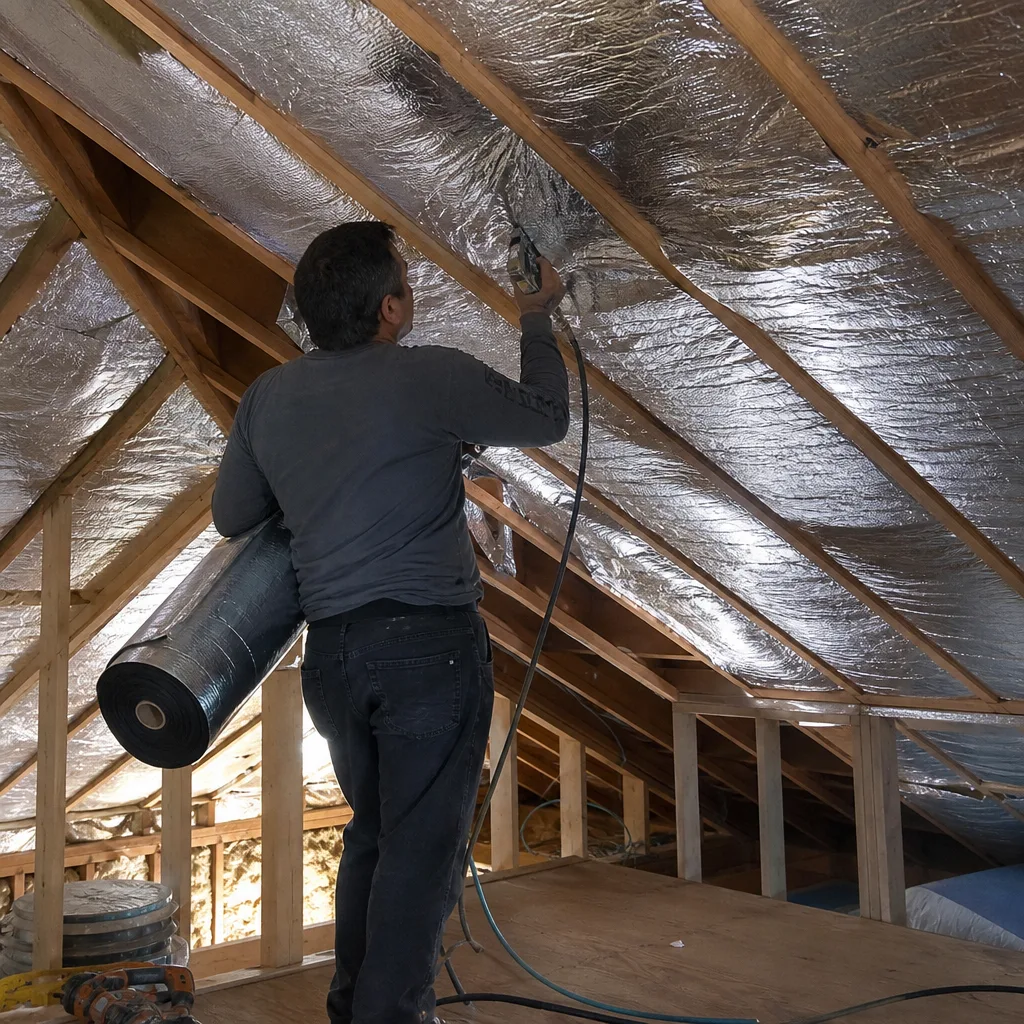
- Radiant barrier: a reflective foil installed under the roofline that reflects radiant heat away from the attic floor. In Costa Mesa’s sun-heavy climate, this single addition can reduce attic temperatures by 20-30°F, which translates directly into lower cooling costs. Works alongside any insulation type.
The short version: in Costa Mesa, moisture resistance and air-sealing ability matter as much as R-value. That’s why we spec products like Knauf blown-in fiberglass for open attics, GreenFiber cellulose for wall retrofits, and closed-cell spray foam where air sealing is the priority. The right material in the right location beats the highest R-value in the wrong one, every time.
Attic Radiant Heat: Costa Mesa’s #1 Comfort Complaint
When Costa Mesa homeowners call us about uneven temperatures, the conversation almost always starts upstairs. A bedroom that’s 8 degrees warmer than the living room in July. A hallway that never cools off. The cause is rarely the HVAC system. It’s attic radiant heat soaking through thin ceiling drywall into the rooms below.
Here’s what happens: Costa Mesa gets roughly 280 days of sunshine per year. Dark roof shingles absorb solar energy and heat up to 150°F or more. That heat radiates down into the attic space, where thin insulation and poor ventilation let it press against the ceiling. Your AC runs constantly fighting heat that arrives from above, not from outside walls. The problem compounds in single-story ranch homes common to Eastside Costa Mesa and the Freedom Homes tract, where every room sits directly under the attic.
- Measure attic temperature on a sunny afternoon. If it’s above 130°F while your thermostat reads 75°F inside, you have a radiant heat problem.
- Check insulation depth. Costa Mesa homes averaged R-19 to R-30 attic insulation in the 1970s and 80s. The Department of Energy now recommends R-38 to R-60 for Zone 7. Most local attics are under-insulated by 50% or more.
- Inspect insulation condition. If the existing loose-fill is compressed, matted, or showing dust accumulation from decades of use, its performance has degraded regardless of how deep it was when installed.
- Add a radiant barrier if the attic gets full sun. A radiant barrier attached to the underside of the rafters reflects the sun’s heat back out before it can soak the attic air.
- Top up or replace insulation to bring the attic to R-38 minimum. We typically install blown-in fiberglass to R-44 or R-49 in Costa Mesa attics.
In our experience, the combination of a radiant barrier and proper attic insulation cuts ceiling surface temperatures by 8-15°F, which is often the difference between a bedroom that cools down at 6pm and one that stays hot until midnight. This is the single highest-impact insulation project for most Costa Mesa single-family homes. Our Attic Insulation in Costa Mesa service starts with a thermal audit, not a sales pitch, so you see exactly where the heat is getting in before we touch anything.
Moisture, Mold, and the Marine Layer Problem
Costa Mesa’s marine layer isn’t just morning fog that burns off by noon. It’s a daily cycle of humidity that penetrates building envelopes in ways cold-climate guides never discuss. Average relative humidity in Costa Mesa runs 65-75% year-round, and many homes see indoor humidity levels above 60% during May Gray and June Gloom. Above 60% indoor humidity, mold growth becomes likely on any organic surface walls, ceiling corners, and especially inside insulation that has absorbed moisture.
Older Costa Mesa homes face a compounding issue: builders in the 1950s through 1970s rarely installed vapor barriers, and many used materials that degrade under persistent humidity. Kraft-faced batts with the paper facing installed backward (a shockingly common original-build error we find in homes across Mesa del Mar and Westside Costa Mesa) actually trap moisture inside wall cavities. The result: hidden mold, musty smells homeowners can’t locate, and insulation that’s essentially doing nothing.
Here’s what actually matters for moisture control in Costa Mesa:
- Air sealing stops the moisture source. Humid air doesn’t magically appear inside walls. It enters through gaps around recessed lights, plumbing penetrations, baseboards, and attic hatches. Sealing those gaps stops both air leakage and the moisture riding on that air.
- Crawl space encapsulation interrupts ground moisture. A bare-dirt or vented crawl space acts like an evaporation engine, pumping groundwater moisture directly into your home. In Costa Mesa, crawl space humidity regularly exceeds 80%, and that air rises through floorboards into living spaces.
- Insulation type determines long-term resilience. Closed-cell spray foam and blown-in fiberglass handle Costa Mesa humidity better than batts. Cellulose with borate treatment resists mold. Know what’s in your walls and attic before chasing moisture problems downstream.
We’ve opened countless walls in Costa Mesa where the moisture reading on the back side of the insulation was above 20%, the threshold where serious degradation begins. The homeowners had no idea because the problem hides behind drywall until the odor or mold appears. This is why our Warmline Insulation Co. moisture assessment comes before any insulation recommendation, never after.
Crawl Space Insulation in a Coastal Climate
Ask ten insulation contractors about crawl spaces in Costa Mesa and you’ll get ten different answers. Here’s what two decades of building science has settled: in humid coastal climates, vented crawl spaces are a liability. Costa Mesa lies just a few miles from the ocean, and the same marine air that makes the evenings pleasant makes crawl spaces damp. Open vents let that humid air in, where it hits cooler surfaces (the underside of your floor, pipes, and foundation walls) and condenses. Wet fiberglass batts hanging between floor joists. Rusted ducts. Musty smells wafting up through floor gaps. And every summer, the same crawl space that’s dripping wet in June bakes dry in August, creating a moisture cycle that degrades insulation and framing year by year.
The fix that actually works in Costa Mesa is crawl space encapsulation: seal the vents, line the ground with a thick vapor barrier, insulate the perimeter walls (not the floor), and condition the space with a small dehumidifier or supply air from the home’s HVAC. This converts the crawl space from a moisture source into a dry, controlled storage area. For homes in flood-adjacent zones like parts of South Coast Metro and areas near the Santa Ana River channel, encapsulation also creates a measurable drainage and drying buffer that open-vented crawl spaces simply don’t have.
When we encapsulate a Costa Mesa crawl space, we follow a specific sequence: remove any wet or moldy insulation and debris, treat for any pest or microbial activity, seal all vents and rim joist gaps, install a 12-16 mil reinforced vapor barrier on the ground and up the foundation walls, and insulate perimeter walls with closed-cell spray foam or rigid foam board. The result is a crawl space that’s dry, measurably warmer in winter, and no longer a humidity engine for the rest of your home.
Air Sealing: The Step Everyone Skips
If we had to pick the single most overlooked component of home insulation in Costa Mesa, it’s air sealing. You can blow R-60 insulation into an attic, but if the attic floor has unsealed gaps around every recessed light, wire penetration, and plumbing chase, conditioned air still leaks out and hot attic air still leaks in. The best insulation in the world can’t stop air movement. Only sealing does.
Consider this: a typical Costa Mesa home has the equivalent of a 2-square-foot hole open to the attic when you add up all the small gaps and cracks. It’s like running your AC with a window cracked open all summer. Every cubic foot of air that leaks out pulls replacement air in from outside, usually from the crawl space or through wall penetrations. That replacement air carries the marine layer’s humidity with it. Air sealing breaks this cycle at the source.
Our air sealing process in Costa Mesa homes follows a systematic approach:
- Attic floor penetrations: foam-seal around every recessed light, ceiling fan box, wire run, and plumbing pipe that goes through the top plate.
- Attic hatch or pull-down stairs: install gasketing and an insulated cover, because the attic access is routinely one of the largest single leaks in the house.
- Top plates and rim joists: seal the gap where wall framing meets attic floor and where floor joists meet the crawl space foundation.
- Recessed lights: replace old non-IC-rated fixtures with airtight, IC-rated models or install covers that allow insulation contact without overheating.
- Duct connections and registers: seal with mastic (not tape, which fails in Costa Mesa attic heat) where ducts meet registers and at the plenum.
Air sealing typically costs a fraction of what a full insulation replacement costs, and delivers the highest return on investment per dollar in Costa Mesa homes. We often pair it with attic insulation because the two work as a system: seal first, insulate second. Insulating an unsealed attic is like filling a colander with water and wondering why it’s still draining.
SoCalGas and SCE Rebates Costa Mesa Homeowners Miss
Costa Mesa homeowners leave real money on the table every year by not claiming utility rebates for efficiency work. Both SoCalGas and Southern California Edison run incentive programs that can offset a meaningful chunk of insulation and air sealing costs. These programs change frequently, and it’s our practice to check current program terms before we quote, but here’s what’s typically available:
- SoCalGas residential energy efficiency rebates: often include rebates for attic and wall insulation upgrades, duct sealing, and smart thermostats. Amounts vary by measure and existing conditions.
- SCE home energy efficiency program: typically covers portions of air conditioning and ventilation improvements, and sometimes portions of envelope improvements when bundled with qualifying measures. Costa Mesa falls in SCE service territory, and many homeowners are eligible for an audit-based path that identifies the highest-impact upgrades for their specific home.
- Home Energy Audit programs: both utilities subsidize professional energy audits that identify exactly which improvements will deliver payback. This is a smart starting point before spending on insulation because it prioritizes measures objectively.
The catch: most Costa Mesa homeowners never claim these rebates because they either don’t know they exist or do the work with a contractor who doesn’t handle the paperwork. We file rebate paperwork for our customers as part of the job whenever a project qualifies, and our home energy audits are designed to identify rebate-eligible measures before we quote anything. If you’ve been putting off insulation work because of cost, checking current rebate programs is the first move, not the last.
Why Attic, Walls, and Crawl Space Must Work Together
Treating insulation as disconnected projects is like patching one flat tire on a car with three others that leak. You might notice a small improvement, but you’re bleeding air everywhere else. Costa Mesa homes perform best when the entire building envelope is addressed as a system, because each component interacts with the others in ways that are invisible until you understand the airflow paths.
Here’s the interaction most homeowners don’t see: your attic air leakage pulls air from your walls. Your walls pull air from your crawl space. Your crawl space pulls humid air from the ground and outside. So an airtight attic but a vented crawl space still leaves the whole system leaky. The same dynamic applies in reverse. A fully encapsulated crawl space with an unsealed attic still loses most of its conditioned air through the ceiling.
This is why we never recommend isolated band-aid fixes. When a Costa Mesa homeowner asks us for “just some blown-in insulation in the attic,” we listen, but we also explain what that insulation will and won’t do without air sealing. When someone wants crawl space encapsulation, we map how that work connects to wall moisture and attic air pressure. The full-spectrum approach doesn’t mean doing everything at once. It means understanding how everything fits together, then sequencing projects in the order that delivers the most comfort and bill reduction per dollar spent.
In practice, the most common sequence we recommend for Costa Mesa homes is: home energy audit first, air sealing second, attic insulation and radiant barrier third, crawl space encapsulation fourth, wall insulation last (or first if walls are completely empty, which we see in older Eastside homes). Every house is different, which is why the diagnostic step matters. A 1960s ranch in College Park needs different sequencing than a 1990s two-story near Fairview Park. Both need the whole system considered, not just one component.
Common Mistakes to Avoid
- Insulating without air sealing. Blowing new insulation over a leaky attic floor wastes a good chunk of your investment. Seal first, insulate second. Costa Mesa’s marine air will exploit every gap you leave.
- Using faced batts where you need moisture resistance. Kraft-faced batts can trap moisture inside wall cavities when installed faced toward the exterior. In Costa Mesa humidity, that means mold inside your walls. Use unfaced batts with a continuous air barrier, or switch to blown-in or spray foam.
- Skipping the radiant barrier. Cooling load, not heating load, drives Costa Mesa energy bills. A radiant barrier addresses cooling load directly and costs less than most people assume. Skipping it leaves the largest single heat gain source unaddressed.
- Leaving the crawl space vented. Building codes used to require crawl space vents, and many Costa Mesa homes still have them open. In our climate, vented crawl spaces pump humidity into the home. Encapsulate and condition instead.
- Not checking rebate eligibility before starting the work. SoCalGas and SCE programs have application timelines and contractor requirements. Start the process before you start the work, or you may disqualify yourself unknowingly.
- Hiring a generalist for insulation work. Insulation is a building-science discipline, not rough carpentry. We regularly encounter homes where a handyman installed batts with gaps, compressed it in places, and left penetrations unsealed. Insulation done wrong is waste locked into your walls for decades.
- Judging insulation by R-value alone. R-value measures resistance to conductive heat flow. It doesn’t measure air leakage, moisture handling, or radiant heat. Costa Mesa’s climate demands performance on all four fronts, not just the number printed on the bag.
When to Call a Professional
Call an insulation specialist when you notice rooms that never cool evenly, energy bills climbing despite no lifestyle changes, musty odors you can’t locate, or attic temperatures you can feel through the ceiling. If your home predates 1980 and hasn’t had insulation work since construction, it’s almost certainly under-insulated by current Zone 7 standards. Damp insulation, visible mold, pest damage in the attic, and open crawl space vents are all signs that a professional assessment will pay for itself. Working with high-tension attic materials and installing spray foam involves equipment and safety considerations that make it a genuine professional job, not a weekend project. If you’re unsure how to vet a contractor, read our guide on How to Hire a Insulation Contractor in Costa Mesa: A Step-by-Step Guide. Warmline Insulation Co. offers free estimates in Costa Mesa, and a live person answers the phone 24/7. Call (657) 224-2897 and we’ll set up a time to assess your home, no obligation.
Frequently Asked Questions
For a detailed Insulation Cost Breakdown: The Costa Mesa Homeowner’s Reference for 2026, attic insulation in Costa Mesa typically costs $1,500 to $4,500 depending on square footage and target R-value, while crawl space encapsulation runs $3,500 to $8,000 for a standard single-story home. Spray foam costs more per square foot but adds air sealing that fiberglass alone doesn’t provide. Call (657) 224-2897 for an exact quote; estimates are free and a live person answers around the clock.
For Climate Zone 7 where Costa Mesa sits, the Department of Energy recommends R-38 to R-60 in attics, R-13 to R-15 in walls, and R-25 to R-30 in floors. Most older Costa Mesa homes are at R-19 to R-30 in the attic, roughly half of current recommendations. A quick attic inspection will tell you where you stand.
In Costa Mesa’s marine-influenced climate, vapor barrier placement is frequently done wrong and makes moisture problems worse. The solution that works here is air sealing plus insulation materials that manage moisture naturally, like closed-cell spray foam or blown-in fiberglass, rather than adding a separate vapor barrier that can trap humidity inside walls. Have a professional assess your specific wall assembly before adding any vapor control layer.
Yes, in many cases we can add blown-in insulation over existing attic insulation to reach the target R-value, provided the existing material is dry, mold-free, and not contaminated by pests. Wall insulation retrofits and crawl space work may require removal first. A free inspection determines the right path for your specific home.
Most attic insulation jobs are completed in a single visit, typically 4 to 8 hours depending on size and scope. Crawl space encapsulation takes one to two days. Air sealing combined with attic insulation usually fits in one full day. We schedule most jobs in Costa Mesa within the same week, and most are done in a single visit.
Yes. We see Costa Mesa homeowners cut cooling costs by 20-35% after air sealing and bringing attic insulation to R-44 or above, especially when combined with a radiant barrier. The payback is faster in Costa Mesa than in inland areas because we run AC year-round, not just in summer. We’ve documented the results on homes throughout Mesa Verde, College Park, and Eastside Costa Mesa.
The Bottom Line
Costa Mesa’s climate demands a different insulation approach than what national guides teach. The real performance killers here are marine humidity, attic radiant heat, and air leakage, not cold winter nights. Homes that address those three factors with moisture-resistant materials, a radiant barrier, and systematic air sealing see meaningful drops in cooling costs and a big improvement in comfort. Start with a free assessment, check your rebate eligibility, and treat the whole building envelope as one system, not a series of disconnected projects. Browse more guides & resources on optimizing your home’s efficiency. If your home is under-insulated and leaking conditioned air, every month you wait is money you’re giving to SCE and SoCalGas for nothing.
Written by Neil Ashford, Owner at Warmline Insulation Co., serving Costa Mesa since 2011.