
Last updated September 16, 2026
Seasonal Insulation Care for Costa Mesa: Year-Round Homeowner’s Guide
Santa Ana wind events push hot, dry air through every gap in a building envelope, and they’re one of the least-discussed causes of attic insulation displacement in Orange County. Loose-fill fiberglass and blown-in cellulose get shifted, compressed, and blown away from eaves without leaving any visible trace from the ground. A Costa Mesa homeowner can lose 20 to 30 percent of their attic’s R-value over two or three windy seasons and never know it until the August electric bill arrives. This guide explains what to check each season, why Costa Mesa’s specific weather patterns matter more than generic maintenance advice, and how 20 minutes of seasonal attention protects the insulation investment in your home.
Quick Answer
Seasonal insulation care in Costa Mesa means checking your attic before and after Santa Ana wind season, inspecting crawl space vapor barriers after winter rain, verifying attic ventilation balance before June Gloom humidity settles in, and confirming attic insulation hasn’t compressed during summer heat. Most homeowners can complete these checks in under half an hour per season, and catching displacement or moisture problems early prevents the slow, invisible loss of R-value that drives up energy bills year-round.
Table of Contents
- Why Costa Mesa’s Climate Demands a Different Insulation Calendar
- Fall: Pre-Santa Ana Attic Inspection
- Winter: Post-Rain Crawl Space and Vapor Barrier Check
- Spring: June Gloom Preparation and Ventilation Balance
- Summer: Radiant Heat and Compression Check
- Your Year-Round Insulation Log Template
- Common Mistakes to Avoid
- When to Call a Professional
- Frequently Asked Questions
- The Bottom Line
Why Costa Mesa’s Climate Demands a Different Insulation Calendar
Most insulation maintenance guides are written for places with four real seasons: freezing winters, wet springs, humid summers, crisp autumns. Costa Mesa doesn’t play by those rules. We have two seasons that matter for insulation: wind season and marine layer season, with rain sprinkled unpredictably between November and March. The rest of the country worries about ice dams and frozen pipes. We worry about wind-driven dust infiltrating attic bypasses and sustained 70 percent humidity feeding mold in under-ventilated crawl spaces.
Here’s what actually stresses insulation in this specific coastal microclimate:
- Santa Ana winds (September through February, peaking October and November): Gusts routinely hit 40 to 60 mph in Costa Mesa’s canyon-adjacent neighborhoods. That’s enough to displace loose-fill insulation in attics, especially near soffit vents and gable ends.
- June Gloom (May through July): The marine layer parks over the coast for weeks. Outdoor humidity sits at 70 percent or higher, and any attic with imbalanced ventilation holds that moisture against insulation, slowly degrading fiberglass batts and encouraging mold on the underside of roof decking.
- Winter rain events (November through March): Costa Mesa gets 12 to 14 inches of rain annually, but it arrives in a handful of concentrated storms. A single atmospheric river can drop three inches of rain in 24 hours, and crawl spaces without intact vapor barriers stay damp for weeks afterward.
- Summer radiant heat (July through September): Attic temperatures in Costa Mesa regularly exceed 130°F on August afternoons. That heat doesn’t just test your air conditioner; it degrades insulation over time, especially spray foam applied too thin or fiberglass compressed against roof decking.
Understanding this calendar matters because every season has a specific, predictable failure point. And once you know what to look for, you can catch problems before they compound. That’s what the rest of this guide covers.
We’ve spent over 15 years inspecting attics and crawl spaces across Costa Mesa, and we’ve seen the same patterns repeat year after year. Homes in Mesa Verde face different wind exposure than homes in College Park. Slab-on-grade homes in the newer developments near South Coast Plaza don’t have crawl space concerns at all, but their attic ventilation matters even more. The advice below applies to every home, but we’ve flagged neighborhood-specific considerations where they matter.
If you haven’t had a professional look at your insulation in the last three years, the first step is a home energy audit from Warmline Insulation Co. to establish a baseline. Think of it as the diagnostic starting point that makes every seasonal check smarter and more targeted. Without knowing where your thermal envelope leaks, you’re guessing.
Fall: Pre-Santa Ana Attic Inspection
September is the most important month on the Costa Mesa insulation calendar. Santa Ana season starts in earnest by early October, and the winds that sweep through the Santa Ana River canyon and across the mesa will exploit every gap, bypass, and weak point in your attic. The single highest-leverage task you can complete in under 30 minutes is a pre-wind inspection of loose-fill insulation and attic bypass gaps.
Here’s what we look for when inspecting attic insulation in Costa Mesa before wind season:
Step-by-Step Fall Attic Check
- Check loose-fill depth near soffit vents. Santa Ana winds enter through soffit vents and push loose-fill insulation away from the eaves. If you see bare drywall or rafters near the perimeter while the center of the attic still has 12 to 14 inches of coverage, wind displacement is already happening. Blown-in fiberglass from Owens Corning or GreenFiber shows this pattern clearly because the displaced material piles up in drifts toward the center of the attic floor.
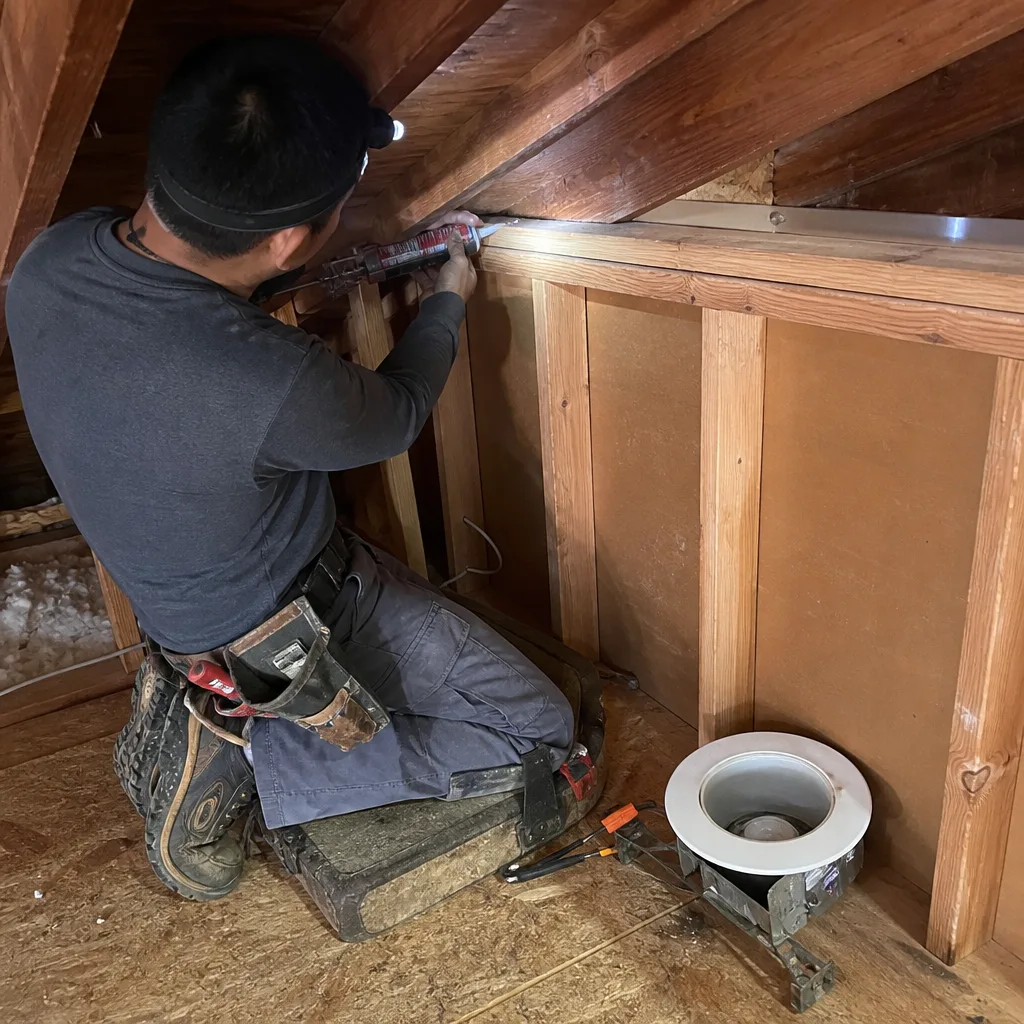
- Inspect recessed light housings from above. Older recessed cans are uninsulated and create direct bypasses from conditioned space into the attic. During wind events, these gaps act like small chimneys, pulling dust and particulate up through the fixture. Look for brown staining on insulation around each can, a telltale sign of air movement.
- Look for dust streaks on insulation. Wind-driven dust doesn’t just settle; it gets pushed through gaps and leaves visible gray-brown streaks on the surface of insulation. If you see streaking, you’ve found an air bypass. Track it back to the penetration: a wire chase, a plumbing vent, a top plate gap.
- Verify baffles are still in place. The cardboard or foam baffles that keep insulation from blocking soffit vents can shift or blow out entirely during the previous year’s wind events. When baffles fail, insulation blocks the vent, and your attic loses its intake ventilation exactly when it matters most.
- Check for rodent activity. Santa Ana season pushes rodents looking for warm nesting sites into attics. Look for tunnels through blown-in insulation, droppings, and chewed wiring. Attic cleaning and rodent proofing are part of what we handle regularly, and this is the season when the problem peaks.
The most common fix for wind displacement is adding more loose-fill insulation and installing wind-wash barriers at the eaves. In our experience across Costa Mesa homes, the northeast-facing eaves take the worst of it during Santa Ana events, because prevailing winds enter from the canyons to the northeast of the city. We also recommend verifying that all bypass penetrations are sealed with foam or caulk, because wind doesn’t just move insulation; it pushes conditioned air out of your home through the same gaps, and that’s money leaving your house every hour the wind blows.
If your attic has blown-in insulation in Costa Mesa that has drifted or compacted over several wind seasons, a top-off or full replacement may be in order. We use Owens Corning AttiCat and GreenFiber blown-in products on most jobs because they resist settling better than older fiberglass products.
Winter: Post-Rain Crawl Space and Vapor Barrier Check
Costa Mesa’s rain arrives in bursts. A dry November might be followed by a December storm that drops two inches in an afternoon. When that water hits saturated soil around your foundation, it moves laterally into the crawl space unless a vapor barrier is intact and correctly installed. The winter check should happen within a week after the season’s first significant rain event, then again after any storm that drops more than an inch.
Here’s what to inspect under your house:
Step-by-Step Winter Crawl Space Check
- Look for standing water or damp soil. The first sign of a failed vapor barrier is water pooled on top of the plastic sheeting, or the smell of damp earth from the crawl space vents. Neither should be present within 48 hours after rain stops. If you see either, the barrier has a breach or was never properly lapped at the seams.
- Check vapor barrier seams and edges. A proper crawl space vapor barrier in Costa Mesa homes should cover 100 percent of exposed soil and extend 6 to 12 inches up the foundation walls and piers. Seams should overlap by at least 12 inches and be taped or mechanically fastened. If you see bare soil anywhere, the system is compromised.
- Inspect underfloor insulation for moisture damage. Fiberglass batts in the floor joists will sag, stain, and lose their bond to the subfloor when they absorb moisture. Wet insulation has an R-value near zero, and it keeps the joists wet, too, which is how dry rot starts. In a damp crawl space, insulation can go from functional to ruined in a single rainy winter.
- Check vents for debris and screen integrity. Rodents and leaves clog crawl space vents over time. A blocked vent means the crawl space can’t dry out after rain. A broken screen means access for pests. Both are simple fixes that protect the entire underfloor insulation assembly.
- Look for mold on joists and subfloor. Black or green staining on the underside of the floor means the crawl space has had a moisture problem for a while. This is not a cosmetic issue; it’s a sign that the vapor barrier has failed and the space needs professional attention.
Crawl space encapsulation is the most complete solution for Costa Mesa homes with recurring moisture issues, and it’s one of the services we provide. A fully encapsulated crawl space includes a heavy-duty vapor barrier across the floor, sealed foundation vents, insulated walls, and a dehumidifier sized to the space. Homes in the older neighborhoods of Costa Mesa, especially those built before 1980 on raised foundations, are the most common candidates, because original vapor barriers were typically 4-mil poly that degrades completely within a few decades.
But encapsulation isn’t always necessary. In many cases, a properly installed 12-mil reinforced vapor barrier with taped seams and correct wall coverage solves the problem for a fraction of the cost. That’s why we always start with a crawl space inspection rather than jumping to a recommendation.
Spring: June Gloom Preparation and Ventilation Balance
By late May, the marine layer settles over Costa Mesa and doesn’t leave for weeks. Outdoor humidity hangs between 65 and 80 percent, and any attic that isn’t properly ventilated holds that moisture against the insulation and the underside of the roof deck, setting up conditions for mold, mildew, and insulation degradation. The spring check is about one thing: making sure your attic ventilation is balanced and functioning before the gloom arrives.
Here’s the problem in simple terms: your attic needs equal amounts of intake ventilation at the eaves and exhaust ventilation at or near the ridge. When that balance is off, the attic can’t move air. Moisture-laden air from the house rises into the attic during June Gloom season and stays there, soaking into fiberglass batts and blown-in cellulose. Over a few weeks, insulation loses loft and R-value. Over a few seasons, you get mold on the roof deck and insulation that needs removal and replacement.
What to Check Each Spring
- Soffit vent clarity: From outside, look up at the underside of your eaves. Each vent should be visible and unobstructed. If insulation has pushed forward and blocked the intake path, your exhaust fans (ridge vents, turbines, or powered attic fans) have nothing to pull from.
- Ridge vent condition: On the roof, the ridge vent should be intact along its full length with no debris accumulation. A ridge vent that’s missing shingle tabs or has been painted over during a roof job isn’t venting.
- Powered attic fan operation: If your home has a powered attic ventilator, confirm it cycles on when the attic warms up. Many Costa Mesa homes have fans that failed years ago, and the homeowners never knew because the attic “seemed fine” during the dry season.
- Bathroom and kitchen exhaust routing: This is one of the most common attic moisture sources we find during spring inspections in Costa Mesa. Bathroom fans and kitchen range hoods should vent through the roof or a gable wall to the exterior, never directly into the attic. A single bathroom fan vented into the attic in June Gloom season can add enough moisture to cause visible condensation on the roof deck.
- Insulation moisture content: If your attic has fiberglass batts, press a hand against them near the center of the space. They should feel dry and springy. If they feel damp or heavy, you have a ventilation or air-sealing problem that needs professional attention before summer heat bakes that moisture into the structure.
Spring is also the right time to schedule an attic air sealing project in Costa Mesa if you’ve never had one done. Air sealing closes the bypasses that let humid house air into the attic in the first place. It’s the preventive measure that makes everything else work better, and it’s the single most cost-effective home performance improvement most coastal Orange County homeowners can make.
Summer: Radiant Heat and Compression Check
By August, a Costa Mesa attic can sit above 130°F. That’s not an anomaly; it’s the normal operating condition of an insulated coastal attic in late summer, and it’s why summer is the season when attic insulation issues show up in your cooling bill. But there’s a specific failure mode we see in Costa Mesa homes that most homeowners don’t know to check for: insulation that has compressed against the roof deck, eliminating the airspace that matters most.
Here’s the physics in plain terms. Radiant heat from the roof deck transfers into the attic through three paths: conduction (direct contact), radiation (heat waves crossing the air gap), and convection (hot air rising). A ventilated attic with a proper air gap between the roof deck and the insulation manages all three. When insulation is jammed against the roof deck, either because someone overfilled the space or because material shifted over the years, you lose the air gap and heat conducts directly into the thermal boundary, effectively transferring outside conditions into your home.
Summer Attic Check: What to Look For
- Check for insulation touching the roof deck. From inside the attic, look at where the rafters meet the top plates. There should be 1 to 2 inches of clear airspace between the underside of the roof deck and any insulation. If you see fiberglass or cellulose pressed against the deck, it needs to be pulled back or reduced in depth.
- Feel for hot spots through the ceiling. On a hot afternoon, walk through the top floor of your home with your hand against the ceiling. In a properly insulated attic, the ceiling should feel uniformly close to room temperature. Hot spots that map to specific areas of the attic usually mean either missing insulation or compressed insulation above those points.
- Check for radiant barrier delamination. If you have a radiant barrier installed on the underside of the roof rafters, look for sagging, tearing, or gaps at the seams. A radiant barrier with gaps lets radiated heat bypass straight through. Small tears can be re-fastened; widespread delamination means replacement is more cost-effective.
- Verify insulation depth is uniform. Use a ruler or measuring tape to check depth in several locations across the attic floor. Significant variation (for example, 14 inches near the center and 6 inches near the perimeter) means wind displacement or prior rodent activity has moved material. The fix is topping off with additional blown-in insulation, not just raking what’s there flat.
- Listen for your air conditioner running longer than you’d expect. This is the non-attic clue. If your AC runs consistently longer cycles in August than it did the previous year, and nothing else has changed in the home, something has degraded in the thermal envelope. Attic insulation displacement and compression are the first suspects.
For Costa Mesa homes built in the 1960s through 1980s, original attic insulation was often R-19 fiberglass batts, which is about half of what current California Title 24 standards call for. If your home still has original batts, summer is the season when the deficiency is most obvious, because the cooling system simply can’t keep up with the heat load entering through the attic. Upgrading to blown-in insulation at R-38 or R-44, combined with air sealing, is the highest-ROI improvement for older Costa Mesa homes.
One more note on summer: if you’re considering spray foam insulation, summer is the season when its benefits are most apparent in Costa Mesa. Closed-cell spray foam from Demilec or Icynene creates an air seal and insulation in one step, which means wind displacement never happens, and the airspace against the roof deck is preserved by design. It’s a more involved installation than blown-in, but for homes with chronic wind displacement issues or complicated rooflines, it eliminates the problem permanently.
Your Year-Round Insulation Log Template
Catching degradation trends early requires tracking what you see year over year. A simple log, kept on paper or in a notes app, is enough. Here is the template we recommend to Costa Mesa homeowners, and it takes less than five minutes per season to fill out:
Seasonal Insulation Log
- Date of check: e.g., September 15, 2026
- Season and trigger: Pre-Santa Ana / Post-Rain / Pre-June Gloom / Peak Summer Heat
- Attic insulation depth (center / mid / perimeter): three measurements, in inches
- Visible displacement or compression: yes/no, describe location
- Dust streaks on insulation: yes/no, note which penetrations they trace to
- Moisture or dampness in attic: yes/no, note location
- Crawl space status: dry / damp / standing water
- Vapor barrier condition: intact / seam gap / tear / missing in areas
- Ceiling hot spots noticed during peak heat: yes/no, note rooms
- Action taken: none / minor DIY fix / scheduled professional inspection
After two years of seasonal entries, patterns become obvious. A home that loses two inches of blown-in depth along the northeast eaves every Santa Ana season needs wind-wash barriers, not just another top-off. A crawl space that shows dampness after every December storm needs a vapor barrier replacement, not another season of hoping. The log turns vague impressions into a record you can act on.
Common Mistakes to Avoid
- Raking displaced insulation flat without adding material. When Santa Ana winds displace loose-fill, the material doesn’t just move; it compresses. Raking it flat gives the appearance of even coverage, but compressed fiberglass has permanently lower R-value per inch. The fixed depth may look right, but the thermal performance is degraded. Add new material to reach the correct installed depth.
- Ignoring a small crawl space damp spot because “it dries out in summer.” A vapor barrier breach that lets water in during January rain also lets humid air in during the rest of the year. Underfloor insulation doesn’t recover from repeated moisture exposure, and the joists don’t either. The fix gets more expensive every season you wait.
- Blocking soffit vents to “keep the wind out.” Some homeowners respond to wind displacement by covering soffit vents entirely. This stops the wind, but it also stops ventilation, which creates a moisture problem that’s worse than the original displacement. The correct solution is wind-wash baffles that direct air up over the insulation, not block it entirely.
- Venting a bathroom fan into the attic because “that’s how it was done.” Yes, many Costa Mesa homes built before the 1990s have bathroom fans venting directly into the attic. That doesn’t mean it’s acceptable. It means those attics have been accumulating moisture for decades, and the insulation has been paying the price. This is a code violation on any new work and a high-priority fix on existing homes.
- Skipping the pre-Santa Ana check because “the attic looked fine last year.” Wind displacement is incremental. A home that lost three inches of insulation last wind season didn’t show it in the July bill, because the cooling load difference was small. Over four or five seasons, the cumulative loss becomes significant. The attic check is cheap; the accumulated energy waste is not.
- Assuming newer homes don’t need seasonal checks. New construction in Costa Mesa has better insulation to meet Title 24, but construction quality varies, and air sealing is often minimal. A five-year-old home can have attic bypasses, incomplete insulation coverage, or missing vapor barrier laps. Every home benefits from seasonal attention.
When to Call a Professional
Some seasonal checks turn up findings that need more than a homeowner can address: standing water in the crawl space after rain, widespread mold on roof decking or insulation, rodent activity in the attic, or blown-in insulation that has drifted more than a few inches from the eaves. If you see any of these, or if your log shows a pattern of degradation across multiple seasons, a professional inspection is the right next step. Warmline Insulation Co. offers free estimates in Costa Mesa, and we’ve been serving the city since 2011. A live person answers our phones 24/7, so if you find something in an evening or weekend check, call (657) 224-2897 and we’ll walk you through what you’re seeing before scheduling a visit. Most jobs are completed in a single visit, and every project is backed by our 90-Day Done Right Promise.
Frequently Asked Questions
Check your attic insulation four times a year, aligned with Costa Mesa’s seasonal stress points: once before Santa Ana season (September), once after the first significant winter rain (December or January), once before June Gloom settles in (May), and once during peak summer heat (August). Each check takes 20 to 30 minutes and covers different failure modes, because each season stresses insulation differently.
Yes, Santa Ana winds damage attic insulation in Costa Mesa every year. Gusts enter through soffit vents and displace loose-fill insulation away from the eaves, creating bare spots that show up as hot zones in summer and cold zones in winter. Over multiple wind seasons, the cumulative R-value loss can exceed 30 percent without any visible sign from the ground. If your home has blown-in insulation, a pre-wind check each September is the cheapest insurance you can buy.
June Gloom keeps outdoor humidity above 65 percent for weeks at a time, and if your attic ventilation is unbalanced or your bathroom fans vent into the attic, that moisture saturates your insulation. Wet fiberglass loses most of its R-value, wet cellulose settles and compacts, and sustained moisture on the roof deck leads to mold. The fix is proper ventilation balance and air sealing before the marine layer arrives, not after the damage is done.
Attic insulation replacement in Costa Mesa typically runs $1.50 to $3.50 per square foot for blown-in fiberglass or cellulose removal and replacement, depending on attic accessibility and depth. Air sealing adds $0.75 to $1.50 per square foot on typical jobs. A 1,500-square-foot attic with R-38 blown-in and full air sealing generally falls between $3,500 and $6,500. For an exact quote on your home, call (657) 224-2897, estimates are free.
Small vapor barrier tears can be patched by a homeowner using 6-mil or thicker poly and seam tape, as long as the rest of the barrier is intact and the crawl space is dry. But if you’re seeing standing water, damp soil across large areas, or mold on the joists, the problem is beyond a patch. Crawl space encapsulation or a full vapor barrier replacement in Costa Mesa involves sealing foundation vents, possibly adding a dehumidifier, and ensuring proper drainage, all of which require professional installation to be effective.
If your home was built before 1990 and still has original insulation, you’re almost certainly under-insulated by current standards. Homes from that era in Costa Mesa typically have R-11 to R-19 in the attic, versus the R-38 to R-44 that Title 24 now calls for. The upgrade path starts with a home energy audit to find the actual deficiencies, followed by air sealing and insulation to the correct depth. Most homeowners in Costa Mesa see payback within three to five years on the combined project.
The Bottom Line
Costa Mesa’s climate doesn’t punish neglect the way a Minnesota winter or a Houston summer does, which is exactly why insulation problems develop so quietly here. Santa Ana winds steal R-value a little at a time. June Gloom degrades insulation that never gets a chance to dry. Winter rain breaches vapor barriers and rewrites what your crawl space can do for your floors. And every season, the energy bill tells the story, whether you’re reading it or not. The calendar above takes 20 minutes per season and catches every major failure mode before it compounds. Start with a fall attic check, keep the log, call (657) 224-2897 when you see something you can’t explain, and your insulation will do its job every month of the year.
Written by Neil Ashford, Owner at Warmline Insulation Co., serving Costa Mesa since 2011.