
How Much Does Insulation Removal & Replacement Cost in Costa Mesa?
Insulation removal and replacement in Costa Mesa typically costs between $1,400 and $4,800 for a standard single-story home, with most attic projects landing around $2,200 to $3,100 when you factor in vacuum removal, attic prep, and new blown-in or batt installation. Crawl space work runs a bit higher per square foot due to access and moisture conditions common in coastal Orange County homes. Most jobs are completed in a single visit, so you’re not waiting around for a second appointment to get your home back in order.
Insulation Removal & Replacement Cost Breakdown (2026)
The table below reflects what Warmline Insulation Co. actually sees in the Costa Mesa market in 2026 – pricing varies by home size, insulation type, existing material condition, and whether any air sealing or mold remediation is needed before new material goes in.
| Service | Typical Cost Range (Costa Mesa, 2026) | Notes |
|---|---|---|
| Attic Insulation Removal Only (vacuum) | $600 - $1,200 | Per average 1,000-1,500 sq ft attic; includes bagging and disposal |
| Attic Insulation Removal + Blown-In Replacement (fiberglass or cellulose) | $1,600 - $3,200 | Most common project type in Costa Mesa; GreenFiber or Knauf cellulose |
| Attic Insulation Removal + Spray Foam Replacement | $2,800 - $5,500 | Icynene or Demilec open-cell; best for air-sealed attic assemblies |
| Attic Insulation Removal + Batt Replacement (fiberglass or Rockwool) | $1,400 - $2,800 | Common in older Costa Mesa homes with rafter bays; Owens Corning or Rockwool batts |
| Crawl Space Insulation Removal + Replacement | $1,800 - $4,200 | Includes vapor barrier check; coastal homes often need encapsulation upgrade |
| Wall Insulation Removal + Replacement (drill-and-fill) | $1,200 - $3,500 | Per typical 1,200 sq ft wall area; CertainTeed or blown-in fiberglass |
| Air Sealing (add-on during removal) | $300 - $700 | Strong ROI – sealing before new insulation goes in is the smart time to do it |
| Attic Cleaning & Rodent Proofing (add-on) | $400 - $900 | Common in older Eastside Costa Mesa homes near natural corridors |
| Radiant Barrier Installation (add-on) | $500 - $1,200 | Added during replacement for south-facing attics; reduces summer heat gain |
A few things move these numbers significantly. Homes built before 1980 in areas like Eastside Costa Mesa or the older streets near Newport Boulevard sometimes have asbestos-containing vermiculite or older mineral wool that requires certified abatement before standard vacuum removal can proceed – that adds $800 to $2,500 depending on scope, and it’s something we check for during every free estimate. Rodent contamination, which we see regularly in attics near the Fairview Park and South Coast Metro corridors, adds removal complexity and triggers the need for sanitizing and rodent-proofing before new material is installed. And if the existing insulation has settled below R-19 in an attic – which is common in 1960s and 70s Costa Mesa tract homes that have never been updated – the replacement R-value you choose (we typically recommend R-38 or R-49 for attics here) will influence both material cost and labor time.
One cost item homeowners often miss: disposal. Industrial insulation removal generates significant volume. Our pricing includes bagging and hauling – there are no surprise dump fees at the end of the job.
What Affects Insulation Removal & Replacement Pricing in Costa Mesa
- Home age and existing insulation type: Costa Mesa has a lot of housing stock from the 1950s through the 1970s. Older blown-in vermiculite or compressed fiberglass batts are harder to vacuum out cleanly than newer loose-fill cellulose, which adds labor time and cost. Homes from this era in neighborhoods like College Park or near Paularino often need full removal rather than a simple top-up.
- Attic accessibility: A standard pull-down attic access works fine for most jobs, but some Costa Mesa ranch-style homes have very low-pitch rooflines or unusual framing from mid-century construction that requires more time to navigate safely. Tight quarters slow the work and affect the final price.
- Coastal moisture and mold: Costa Mesa sits close enough to the Pacific that marine layer and morning condensation are a real factor in attic and crawl space performance. We see mold-compromised insulation in crawl spaces fairly regularly, especially in homes without proper vapor barriers. If mold remediation is needed before new insulation can go in, that’s a separate but necessary line item – typically $500 to $1,500 depending on severity.
- Replacement material choice: Blown-in cellulose (GreenFiber, Knauf) is the most cost-effective replacement option for standard attics. Rockwool batts cost more but offer better fire resistance and sound dampening – a real benefit for homes near the 405 or 55 freeway corridors. Spray foam from Icynene or Demilec is the highest-performing option for air-sealed assemblies but also the most expensive. We’ll walk you through the tradeoffs, not just the price tag.
- Rodent damage and contamination: Rat and mouse activity is more common than most homeowners realize in Costa Mesa’s older residential neighborhoods. Contaminated insulation requires full removal (not partial), sanitizing with an EPA-registered product, and exclusion work before new material goes in. This is a legitimate health and IAQ issue, not an upsell.
- Whether air sealing is done at the same time: Doing air sealing while the attic is empty is significantly cheaper than scheduling it as a separate job. We always recommend bundling these services – you’re already in there, the material is already out, and the energy savings from a properly sealed and re-insulated attic are substantially better than insulation alone.
How to Save on Insulation Removal & Replacement in Costa Mesa
The single biggest money-saving move is scheduling a home energy audit before committing to any scope of work. An audit identifies exactly where your home is losing energy – sometimes the answer is the attic, but occasionally it’s the crawl space vapor barrier or wall cavities that are the real culprits. Spending $89 on a seasonal tune-up that includes an insulation assessment can prevent you from paying for removal in the wrong location.
If your project total comes to more than $250 – and most removal and replacement jobs do – you qualify for $50 off under our standing repair discount. Seniors and veterans get a permanent 5% discount on every job, every time. These are real line items on your invoice, not marketing language.
Bundle services during the same visit whenever possible. Adding air sealing, a radiant barrier, or attic cleaning to a removal-and-replacement job costs less than scheduling each separately because the setup time and attic access overhead is already built in. In a south-facing attic on a Costa Mesa home, pairing a radiant barrier with new blown-in insulation can cut summer cooling loads noticeably – and the combined cost is often less than doing each service a year apart.
Get your estimate before summer. Demand for insulation removal spikes in April and May as homeowners prep for the coastal heat season, and scheduling is easier in late winter or early fall. We offer free estimates with upfront pricing – no fuzzy “we’ll know when we get in there” quotes. Call (657) 224-2897 and a live person will pick up, any time of day.
Check for utility rebates. Southern California Edison and SoCal Gas both run rebate programs for insulation upgrades that meet specific R-value thresholds. We can advise on which projects qualify – it’s worth asking before you schedule.
Finally, don’t delay on contaminated insulation. Rodent-damaged or mold-compromised material tends to get worse over time, and the longer it sits, the more it affects indoor air quality and the harder it becomes to remediate. A job that costs $2,400 today can cost significantly more in six months if the contamination spreads or the subfloor is affected.
What the Removal and Replacement Process Actually Looks Like
We walk through this in detail on our Insulation Removal & Replacement in Costa Mesa service page, but here’s the short version of what to expect when Warmline’s crew shows up at your home.
We start with a walkaround and attic inspection before any work begins. This is where we confirm the existing insulation type, check for contamination, look for signs of pest activity, and assess whether air sealing or vapor barrier work makes sense to bundle in. In Costa Mesa, we regularly find attics that were last touched in the 1980s with compressed fiberglass batts sitting at R-11 or lower – far below what Orange County’s climate actually requires for comfort and efficiency.
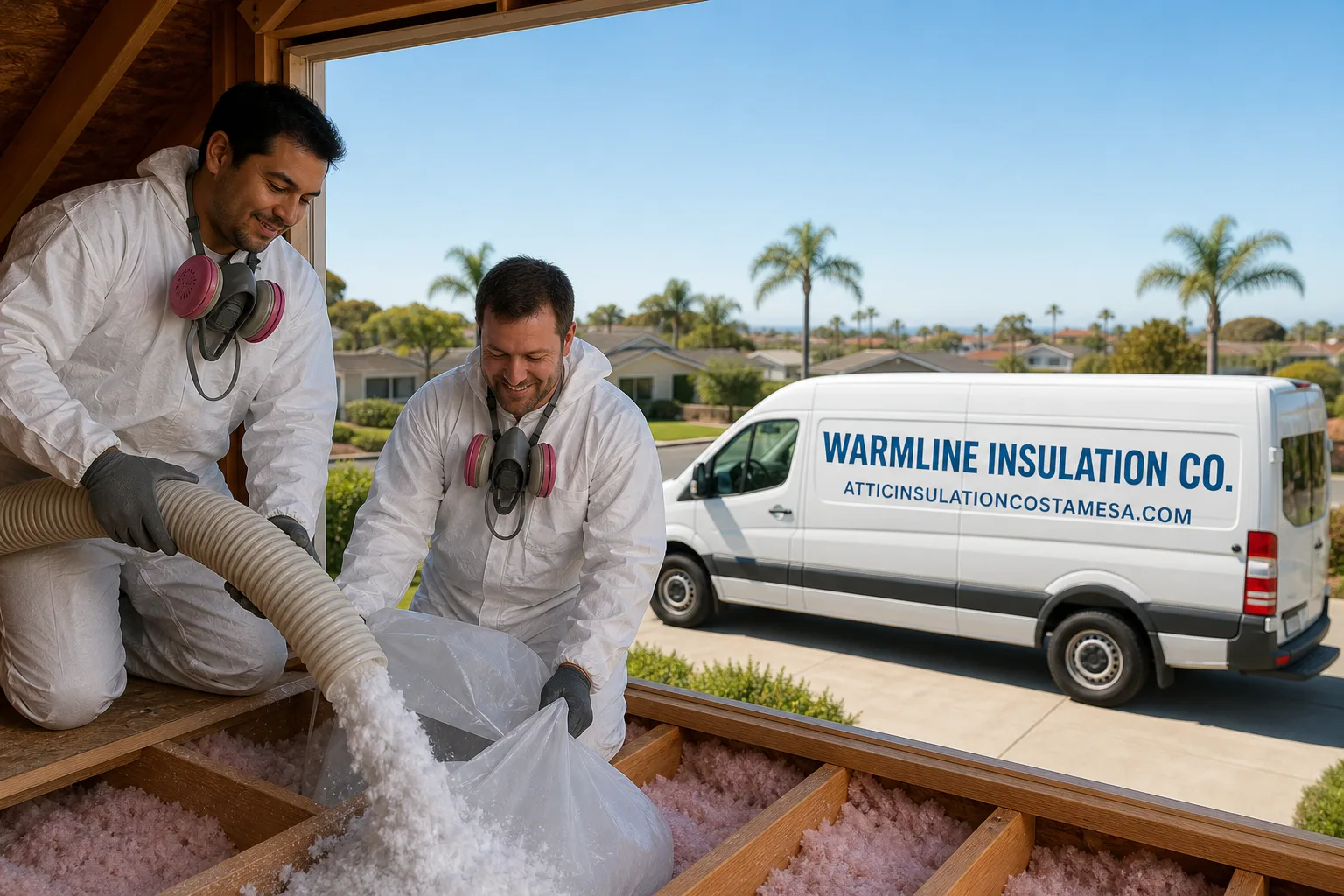
Removal is done with commercial-grade vacuum equipment that runs a hose from the attic directly to a truck-mounted collection unit outside. No material tracked through the house, no dust left behind. The attic is cleared completely before any new insulation goes in.
If air sealing is part of the scope, it happens while the attic is bare. We seal top plates, plumbing and electrical penetrations, recessed light fixtures, and attic hatches – the common leakage points in older Costa Mesa construction. Then new insulation goes in, whether that’s blown-in cellulose from GreenFiber, batts from Owens Corning or Rockwool, or spray foam from Icynene or Demilec, depending on what the attic assembly calls for and what you’ve chosen.
Most jobs are completed in a single day. You’re not scheduling a second visit for the replacement phase – removal and installation happen on the same date, with the same crew. That’s a genuine scheduling advantage for homeowners who can’t take multiple days off work.
All work is backed by Warmline’s 90-Day Done Right Promise. If something isn’t right after we leave, we come back and make it right – that’s a written commitment, not a talking point.
When Removal Is Necessary Versus Optional
Not every insulation project requires full removal. Sometimes a top-up is the right call – adding blown-in cellulose on top of existing material to bring an attic up to R-38 or R-49 without pulling anything out. But there are situations where removal is not optional:
- Rodent or pest contamination – nesting material, droppings, and urine-saturated insulation cannot be topped over and left in place. This is a health issue, and any contractor who tells you otherwise is cutting a corner that will cost you later.
- Mold or moisture damage – wet insulation has zero effective R-value and actively creates conditions for further mold growth. It has to come out.
- Vermiculite insulation (pre-1990 homes) – if vermiculite is present, it needs to be tested for asbestos before any disturbance. This is something we identify during the free estimate.
- Collapsed or severely compressed batts – old fiberglass batts that have compressed below half their original thickness are often easier and more cost-effective to remove than to try to supplement.
- Fire damage or smoke contamination – smoke-damaged insulation absorbs and re-releases odor compounds. Full removal is required before any restoration work.
In Westside Costa Mesa and some of the older tracts near Baker Street, we encounter a mix of all these scenarios. If you’re not sure which category your home falls into, the free estimate will tell you. No guessing, no commitment required.
Why Costa Mesa Homeowners Replace Insulation More Often Than They Expect
Insulation has a functional lifespan, and it’s shorter than most homeowners assume. Fiberglass batts in a vented attic typically perform well for 15 to 20 years before compression and contamination reduce their effectiveness. Blown-in fiberglass can settle significantly over the same period. Cellulose from GreenFiber or Knauf holds up better but isn’t permanent either, particularly in attics with any moisture intrusion.
Costa Mesa’s coastal climate creates specific pressure on insulation performance. Marine layer moisture cycling through a vented attic over years gradually affects fibrous materials. Homes within a mile or two of the Pacific Coast Highway corridor often see faster performance degradation than inland Orange County communities. On top of that, the marine layer means pest activity – roof rats in particular – is a year-round issue in this part of Orange County, not just a seasonal one. We regularly see homes in Eastside Costa Mesa where the insulation has been compromised by rodents for years without the homeowner knowing, because the damage isn’t visible from the living space.
The practical result: if your home is more than 20 years old and has never had its insulation inspected, there’s a reasonable chance the attic material is underperforming. High energy bills, rooms that won’t stay cool in June and July, or humidity issues in the crawl space are common indicators. A free estimate from Neil Ashford’s team at Warmline takes about 45 minutes and answers the question definitively.
FAQs – Insulation Removal & Replacement Cost in Costa Mesa
How much does attic insulation removal cost in Costa Mesa?
Attic insulation removal in Costa Mesa costs $600 to $1,200 for a typical 1,000-to-1,500 square foot attic floor, including vacuum removal, bagging, and hauling. If contamination is present – rodent damage, mold, or suspected asbestos-containing material – expect additional costs for remediation before new insulation can be installed. Call (657) 224-2897 for a free, no-obligation estimate specific to your home’s size and condition.
Is it worth replacing old insulation or just adding on top?
Adding blown-in insulation on top of existing material makes sense when the current insulation is clean, dry, and intact – just compressed or too thin. It is not appropriate when there’s contamination, moisture damage, pest activity, or vermiculite present. In those cases, removal is necessary, not optional. Most Costa Mesa homes we inspect that are 30 or more years old fall into at least one of those categories, so a proper inspection matters before deciding either way. Call (657) 224-2897 for a free assessment.
How long does insulation removal and replacement take?
Most standard attic removal and replacement jobs in Costa Mesa take one day. A 1,200-square-foot attic with blown-in replacement typically runs 6 to 8 hours from crew arrival to cleanup. Larger homes, crawl space projects, or jobs with significant contamination remediation may require a second day. Warmline books removal and replacement on the same visit so you’re not waiting for a separate installation crew.
Does homeowners insurance cover insulation removal after pest or water damage?
It depends on your policy, but many standard homeowners policies in California cover insulation removal and replacement when the damage results from a covered peril – a burst pipe, sudden water intrusion, or in some cases confirmed rodent entry. Gradual wear and general deterioration are typically excluded. We provide detailed written documentation of the damage and scope of work, which homeowners often use to support insurance claims. Call (657) 224-2897 if you need help understanding what documentation you’ll need.
What R-value should replacement insulation be in Costa Mesa?
For attics in Costa Mesa’s climate zone (California Climate Zone 8), the current Title 24 minimum is R-38, but we recommend R-49 for most homes when doing a full replacement – the incremental material cost is modest and the performance difference is real, especially for south-facing attics. For crawl space floors, R-19 is the common standard. For walls, R-13 to R-21 depending on wall cavity depth. The right answer for your specific home depends on the existing assembly, which we assess during the free estimate.
Key Takeaways
- Insulation removal and replacement in Costa Mesa typically costs $1,400 to $4,800 depending on project scope, with most attic jobs falling between $2,200 and $3,100.
- Coastal moisture, older housing stock, and year-round pest pressure in Costa Mesa create specific conditions that make proper removal – not just top-up – necessary more often than in inland markets.
- Bundling air sealing with removal is the highest-ROI combination for most homeowners: you’re already in the attic, and properly sealing before re-insulating dramatically improves performance.
- All Warmline jobs are backed by the 90-Day Done Right Promise – a written commitment to make it right if anything is off.
- Standing discounts: $50 off any repair over $250, 5% senior and veteran discount on every job.
- A live person answers at (657) 224-2897, any time. Free estimates, upfront pricing, no surprises on the invoice.
Ready for a Free Estimate?
If you’re dealing with high energy bills, a stuffy or drafty home, or you suspect pest or moisture damage to your existing insulation, Neil Ashford and the team at Warmline Insulation Co. are ready to take a look. We’ve been serving Costa Mesa homeowners since 2011 – 15-plus years of knowing exactly what Orange County coastal homes need and what they don’t. Our background-checked, uniformed technicians show up on time, the estimate is free with upfront pricing, and most projects are wrapped up in a single day.
Call (657) 224-2897 to schedule your free estimate. A live person picks up every call – no voicemail, no callback runaround. If the work isn’t right, the 90-Day Done Right Promise means we make it right. That’s the only guarantee worth anything.
Written by Neil Ashford, Owner at Warmline Insulation Co., serving Costa Mesa and Orange County since 2011.
Pricing reflects the Costa Mesa market as of 2026. Warmline Insulation Co. offers free estimates – call (657) 224-2897.
What Our Customers Say
"Crawl space smelled musty and the floors were cold. Full encapsulation with the thick liner taped at every seam, and a dehumidifier sized for the space. The hygrometer they left reads 48 percent now instead of the 70s."
- Elena Vasquez"Upstairs was ten degrees hotter than downstairs every summer. They pulled the attic to bare joists, air-sealed every can light and top plate first, then blew it to R-49. First August in this house where the bedrooms and the living room read the same on the thermostat."
- Marcus Hale"Solid work on the spray foam in the rim joists and the garage ceiling. Scheduling slipped a day because of rain, which they called about ahead of time. Would use them again."
- Tom Reinholt