
Last updated September 16, 2026
Insulation Warning Signs: A Costa Mesa Homeowner’s Reference Guide
When a Costa Mesa homeowner calls an HVAC company about rooms that won’t cool, there’s a better-than-even chance the technician will recommend a new unit, when the real fix is air sealing and insulation that costs a fraction of the price. Failing insulation rarely announces itself with a bang. It shows up as symptoms you’ve probably already noticed: a bedroom that runs eight degrees warmer than the hallway, a musty smell that appears every August, a utility bill that climbed 30% while you changed nothing. Most homeowners misattribute these warning signs to an aging AC system, a quirk of the house, or Costa Mesa’s marine layer. This guide and our Complete Guide to Insulation in Costa Mesa connect the symptom you notice to the specific insulation failure causing it, so nothing gets misdiagnosed or ignored until it becomes a five-figure problem.
Quick Answer
Common signs of bad insulation in Costa Mesa homes include uneven room temperatures, utility bills that spike without an obvious cause, cold or hot walls to the touch, musty odors from crawl spaces, pest evidence in the attic, and ice or condensation forming on interior surfaces during winter. If you notice two or more of these symptoms together, an insulation deficiency is the most likely culprit. A professional energy audit can pinpoint the exact failure in under an hour, and a live person answers the phone at (657) 224-2897 if you want to talk through what you’re seeing.
Table of Contents
- Room-by-Room Symptom Map: Which Failure Causes Which Complaint
- How to Distinguish an HVAC Problem from an Insulation Problem
- Smell and Air Quality Warning Signs
- Visual Warning Signs You Can Check Without a Contractor
- The Urgency Hierarchy: What Needs Attention Now vs. Later
- How Costa Mesa’s Climate Accelerates Insulation Failure
- What Fixing Insulation Actually Involves
- Common Mistakes to Avoid
- When to Call a Professional
- Frequently Asked Questions
Room-by-Room Symptom Map: Which Failure Causes Which Complaint
Your house talks to you through its symptoms. The trick is knowing which failure produces which complaint. In our 15+ years working in Costa Mesa homes, we’ve mapped the most common patterns. Here’s what we consistently find when homeowners describe specific comfort problems.
Bedrooms That Won’t Cool at Night
The classic complaint: the living room cools fine, but the upstairs bedrooms stay stuffy and hot after sunset. Homeowners often blame a weak HVAC blower or leaky ductwork. In many Costa Mesa homes, especially those built before 1980 in neighborhoods like Mesa Verde or College Park, the culprit is attic bypass. The walls between your living space and attic have gaps around wiring chases, plumbing penetrations, and recessed light fixtures. Hot attic air pours into the bedroom walls late in the day, slowly warming the room after the sun goes down. The symptom reads as an AC problem. The failure is air sealing and attic insulation in Costa Mesa that has settled or was never adequate to begin with.
Bathrooms That Feel Cold and Damp in the Morning
If your bathroom feels 5 to 10 degrees colder than the hallway every morning, you likely have either a wall cavity void or a crawl space issue underneath. Homes in Costa Mesa’s older tracts, including parts of Westside Costa Mesa, frequently have wall batt insulation that slid down inside the wall cavity over time. Gravity pulls fiberglass batts down, leaving a void in the upper portion of the wall. The symptom is a bathroom exterior wall that reads cold to the touch. Compounding it, if the crawl space below the bathroom lacks a proper vapor barrier, moisture rises through the floor assembly and chills the room. We’ve opened bathroom walls and found insulation that had effectively collapsed to half its original coverage.
Living Rooms with Cold Floors in Winter
Costa Mesa winters are mild by national standards, but a 50-degree January morning still makes an uninsulated crawl space noticeable. If your living room floor feels cold through your socks while the sofa area feels fine, the crawl space below is a prime suspect. Homes near Fairview Park and the Santa Ana River corridor often have more moisture in their crawl spaces, which makes cold transfer worse. Wet or missing insulation under the floor loses its thermal resistance quickly. This is a crawl space encapsulation problem, not a flooring issue, and adding carpet or rugs only masks the symptom.
How to Distinguish an HVAC Problem from an Insulation Problem
This is the most valuable diagnostic skill a Costa Mesa homeowner can develop, because it saves thousands in unnecessary HVAC replacement. When a room won’t hold temperature, a technician with a sales quota sees a new condenser unit. A building science specialist sees an air boundary failure.
The distinction comes down to two inexpensive checks you can do yourself.
The $30 Infrared Thermometer Test
- Pick a hot afternoon in August or September when your AC is running normally. Order a basic infrared thermometer online or pick one up at any hardware store; $30 gets you a perfectly functional unit.
- Walk your house and point the thermometer at the center of each exterior wall, about chest height. Write down the reading.
- Now point it at an interior partition wall, one that does not touch the outside. Write down that reading.
- Compare the two. A difference of more than 5 degrees between an exterior wall and an interior wall indicates the exterior wall is not properly insulated or has a void.
- Repeat the check in the evening, after the sun has gone down. If the exterior wall remains significantly warmer than the interior wall hours after sunset, you have thermal mass holding heat because insulation is inadequate or missing.
This test takes 20 minutes and gives you hard data. When a wall with full, intact insulation reads within 2 to 3 degrees of an interior partition, that’s normal. A 10-degree gap is a clear indicator that blown-in insulation in Costa Mesa walls has settled, shifted, or was never properly installed.
The Utility Bill Comparison Test
Pull your electricity bills from the same month across the last three years. Southern California Edison bills from July, August, or September work best. Adjust for any rate increases by focusing on usage, measured in kilowatt-hours, not the dollar amount. If your usage in August increased 20% or more over a two-year period without adding square footage, new appliances, or a pool pump, you have an efficiency leak somewhere. An aging AC unit loses some efficiency year over year, but a 20% jump usually points to degraded insulation or air sealing failures. A properly insulated Costa Mesa home should show relatively flat summer usage year over year, because the building envelope protects the HVAC system from working harder as the unit ages.
Run both tests. If the infrared thermometer shows wall temperature gaps and the utility bill shows unexplained usage growth, you have strong evidence of an insulation problem. If the bill is flat and the walls read normally, the issue may genuinely be your HVAC equipment, and a competent technician can address it without padding the quote.
Smell and Air Quality Warning Signs
Insulation failures don’t just change temperature. They change the air you breathe. In Costa Mesa’s climate, with its coastal humidity and morning marine layer, smell and air quality symptoms are often the first indicators something in the building envelope has failed.
Musty Odor That Gets Stronger in Damp Weather
A persistent musty smell is almost always a crawl space problem. Homes in Costa Mesa sit close to sea level, and many crawl spaces run humid from November through April. When a vapor barrier is missing, torn, or improperly installed, moisture moves through the soil and into the wood framing. Insulation batts in the floor assembly absorb that moisture. The result is a smell that rises into the living space, strongest near floor level and in still air. If you notice the musty smell after rain or during Santa Ana driven humidity swings, inspect your crawl space. Wet insulation loses R-value and can grow mold. This is not a cosmetic issue; it’s a health and structural issue that requires spray foam insulation in Costa Mesa or crawl space encapsulation to fix properly.
Dusty or Stale Air When the AC Runs
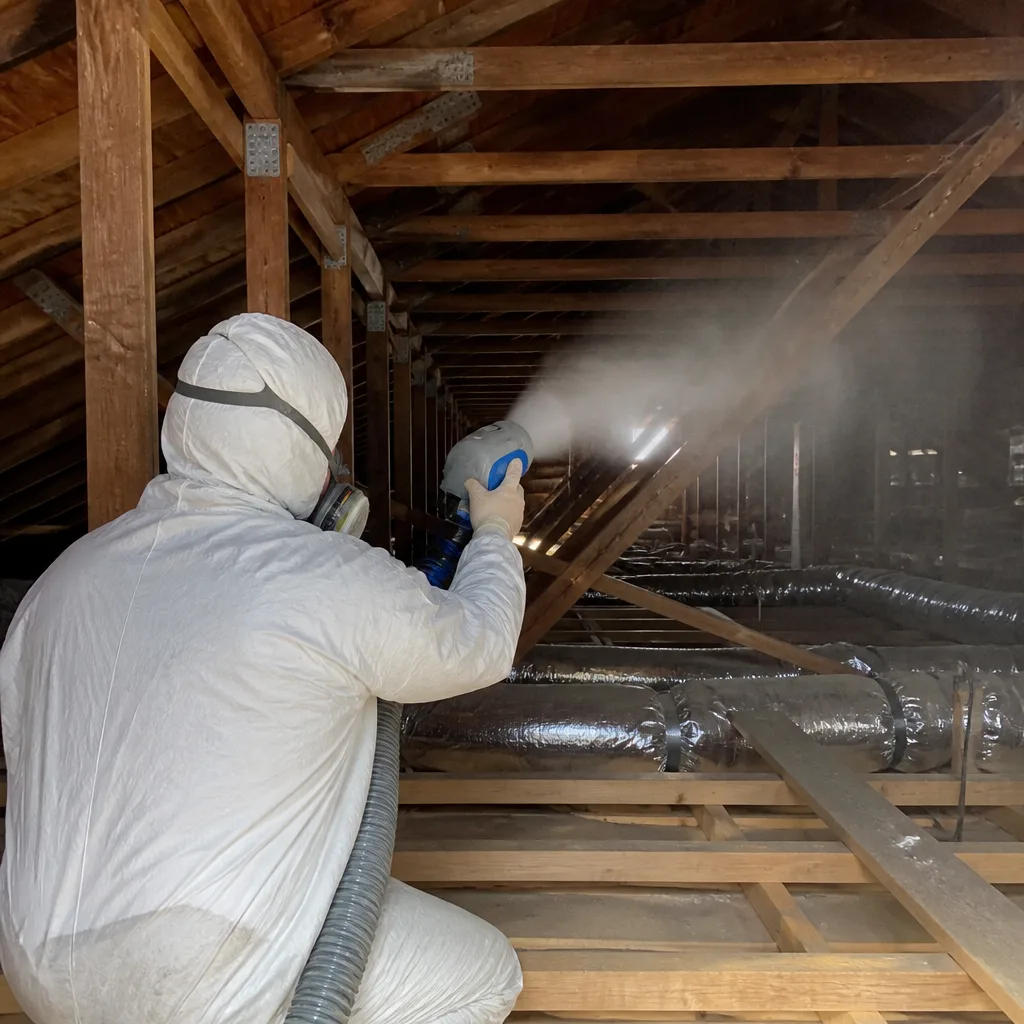
If the air feels dusty or stale when your HVAC blower kicks on, the likely culprit is an attic bypass pulling attic air into the living space. Attics in Costa Mesa homes accumulate fine dust, rodent droppings, pest debris, and fiberglass particles over the years. When attic bypasses exist, the negative pressure created by your HVAC system draws that contaminated air down into the ductwork and into your rooms. The symptom is a stale, slightly acrid smell that appears when the system runs and fades when it stops. The fix is attic air sealing and, in many cases, attic cleaning and rodent proofing, followed by fresh insulation installation.
Rodent Urine Smell in Hallways or Closets
A sharp ammonia-like smell localized to a hallway or closet often indicates rodent activity in the attic or wall cavities. Rats and mice nest in insulation, and their urine and droppings contaminate the material. This is a significant insulation failure because contaminated insulation must be removed and replaced, not simply covered. In Costa Mesa, roof rats are common, especially in neighborhoods with mature trees like Mesa Verde and the Eastside. We regularly remove roof rat nests from attic insulation. The insulation is then replaced with fresh material, often Owens Corning or Johns Manville products, and the entry points are sealed to keep the pests out.
Visual Warning Signs You Can Check Without a Contractor
Several insulation problems are visible if you know where to look. These checks take a few minutes and require no special tools.
- Watermarks on drywall near exterior walls: Brown or yellowish stains that appear near the top of exterior walls or in corners often indicate a roof leak that has saturated attic insulation above. Wet insulation compresses, loses its R-value, and can hold moisture against the drywall for weeks. If you see a watermark, look up. The insulation above it is almost certainly compromised.
- Frost or condensation on interior outlet covers in winter: On cold mornings, place your hand near electrical outlets on exterior walls. If the outlet cover feels cold or shows condensation, the wall cavity behind it likely has a void. Outlets are common bypass points where outside air enters directly through the box. Cold outlet covers in winter are a classic sign of missing or shifted wall insulation.
- Staining on attic insulation: Go into your attic on a sunny day with a flashlight. Look for dark or water-stained patches in the insulation, especially near the eaves, around plumbing vents, or under roof penetrations. Stained insulation has been wet, and wet insulation never fully recovers its thermal performance. Also look for areas where insulation appears thin, uneven, or trampled down.
- Gaps where walls meet floors or ceilings: Run your hand along the seam where exterior walls meet the floor or the ceiling. If you feel a draft, or if a candle flame held near the seam flickers, you have a wall cavity that is leaking air. This indicates missing insulation or air sealing failure at the top or bottom plate of the wall.
- Mold or mildew on crawl space framing: If you can access your crawl space, shine a flashlight at the wooden floor joists. Any dark spots, white fuzzy growth, or a persistent damp sheen indicates a moisture problem. Insulation in a damp crawl space is wet or will be wet soon. Crawl space encapsulation is the fix.
None of these checks requires specialized skill. They require looking at your home the way a building scientist would, not the way a busy homeowner does. When we conduct energy audits in Costa Mesa, these visual indicators are often the difference between a targeted repair and unnecessary guesswork.
The Urgency Hierarchy: What Needs Attention Now vs. Later
Not all insulation failures demand immediate action. Some can wait weeks or months. Others should be addressed within days. Here’s the hierarchy we use when advising Costa Mesa homeowners.
Immediate Action Required
- Active moisture in the crawl space or attic: Wet insulation degrades quickly and promotes mold. If you see standing water, active drips, or saturated insulation, address it within days. The 90-day clock on structural damage and mold growth starts the moment insulation gets wet.
- Pest evidence in the attic: Rodent droppings, nesting material, or evidence of rats or mice in the insulation means the material is contaminated. Pests also chew wiring, which creates a fire hazard. Call an insulation contractor and address the pest issue, the air sealing, and the insulation replacement together. Delaying allows the infestation to expand.
- Visible mold on drywall or insulation: This is a health issue. The insulation must be removed, the moisture source corrected, and fresh material installed. Mold reduces indoor air quality and can trigger respiratory problems.
Schedule Within the Next Few Months
- Uneven room temperatures with normal utility bills: If one room is consistently uncomfortable but your usage is stable, you have an insulation deficiency that is not yet costing you significantly. Schedule an energy audit and plan the repair.
- Cold floors in winter: A crawl space insulation issue degrades comfort but not usually structural integrity in the short term, provided the crawl space is otherwise dry.
- Utility bills up 20% or more: This indicates an efficiency problem worth solving before the next cooling season. You’re losing money every month the problem persists.
Can Wait Until Your Next Major Home Project
- Insulation that has settled but is otherwise dry and pest-free: If your attic insulation has compressed from 12 inches to 8 inches but the home is comfortable and efficient, you can defer replacement. Degraded performance is real, but the urgency is low.
- Radiant barrier missing or damaged: A radiant barrier improves performance in Costa Mesa’s hot summers, especially in homes with high attic temperatures. Missing radiant barrier is an upgrade, not an emergency.
Our technicians see the full spectrum of insulation conditions across Costa Mesa. We’ve never regretted recommending immediate attention to moisture and pest problems, and we’ve never met a homeowner who regretted taking those seriously early.
How Costa Mesa’s Climate Accelerates Insulation Failure
Costa Mesa sits in a unique microclimate. The marine layer rolls in most evenings, raising humidity and dropping temperatures. Afternoon sun bakes roofs in the summer. Winter brings cool, damp air from the Pacific. This combination is rough on insulation, and it produces failure patterns that differ from inland Orange County cities like Santa Ana or Orange, as detailed in our Seasonal Insulation Care for Costa Mesa: Year-Round Homeowner’s Guide.
Moisture from the Marine Layer
The evening marine layer pushes relative humidity above 70% for much of the year. Crawl spaces in Costa Mesa are more susceptible to moisture problems than those in drier inland areas. Insulation batts in crawl spaces absorb humidity, lose R-value, and can remain damp for months. This is why vapor barrier integrity is critical here. A torn or incorrectly installed vapor barrier in Costa Mesa will cause problems much faster than the same tear in Riverside.
Attic Heat in Summer
Costa Mesa afternoon temperatures regularly reach the mid-80s to low 90s in summer. Attic temperatures run 30 to 40 degrees hotter. Radiant heat from the roof deck pushes through whatever insulation exists and into the living space. Over time, fiberglass batts can degrade under repeated heat cycling. Blown-in fiberglass and cellulose materials from brands like GreenFiber hold up well, but installation quality matters more than brand. Improperly installed insulation fails faster in our climate because the thermal stress is higher.
Salt Air and Coastal Proximity
Homes within a few miles of the coast, including most of Costa Mesa, experience salt air. Salt accelerates corrosion on metal components, including HVAC equipment and any metal fasteners used in insulation installation. It also contributes to the breakdown of some insulation materials over long periods. Homes in the Westside and Canyon Park areas, closer to the ocean influence, see this effect most acutely.
For a deeper look at how insulation performs in our specific climate, Warmline Insulation Co. home has detailed information about how we approach Costa Mesa-specific insulation challenges. We’ve been working in these neighborhoods since 2011, and the climate patterns are consistent year over year.
What Fixing Insulation Actually Involves
Once you’ve identified a warning sign, the next question is what the fix looks like. Homeowners often assume insulation work means months of construction chaos. In reality, most insulation repairs in Costa Mesa are completed in a single visit, often in under a day.
Step 1: The Energy Audit
We always recommend starting with a home energy audit. It’s the diagnostic starting point that makes every other service smarter and more targeted. An audit identifies exactly where air leaks are, where insulation has failed, and what the fix should be. You can think of it as the difference between a doctor running tests before prescribing medication and just guessing at the prescription. For homes where the symptom is unclear, an audit often saves thousands by pinpointing the real problem.
Step 2: The Repair or Replacement
Depending on what the audit finds, the work might involve air sealing attic bypasses, adding blown-in insulation to the attic floor, installing spray foam in wall cavities, or encapsulating a crawl space. Each of these is a targeted repair, not a gut remodel. We use materials from manufacturers like Owens Corning, Johns Manville, and Demilec, because proven products from established manufacturers hold up better over 15 and 20 year timeframes than off-brand alternatives.
Step 3: Verification
After the work is done, we verify the results. Thermal imaging before and after the repair shows the difference in real time. Our 90-Day Done Right Promise attaches to every job: if the work isn’t right, we make it right. That’s a written commitment, and it’s one reason Costa Mesa homeowners call us for the fix rather than trying to live with the symptom.
Most jobs are completed in a single visit. A typical attic air sealing and blown-in insulation project takes four to six hours. Crawl space encapsulation may take a day or two, depending on the size of the crawl space. Wall insulation retrofits, done through drill-and-fill techniques, are somewhat more involved but still typically complete within a day or two.
Common Mistakes to Avoid
- Calling an HVAC company for a room that won’t hold temperature before checking the building envelope. Many Costa Mesa homeowners replace a functioning AC unit because a bedroom stays hot, only to discover the problem was attic bypass and missing insulation. Check the walls and the utility bill before you call the HVAC company.
- Adding insulation on top of wet or contaminated insulation. Piling new material over water-damaged or rodent-contaminated insulation seals the problem in. The old material must come out first. Insulation removal and replacement exists for a reason.
- Ignoring a musty smell because it only appears in winter. A crawl space moisture problem that smells in winter is actively degrading your floor framing. Waiting until it smells in summer means waiting until the damage is worse.
- Sealing attic bypasses with expanding foam from a can without proper technique. Air sealing is effective when done systematically, with the right materials, at every penetration. Spot-sealing one or two gaps with a can of spray foam from the hardware store leaves dozens of bypasses open. The result is minimal improvement and a false sense that the job is done.
- Assuming insulation doesn’t fail because it’s inside the walls. Insulation settles, compresses, absorbs moisture, gets chewed by pests, and slides down wall cavities. It fails all the time, especially in homes built more than 30 years ago. Assume the insulation in an older Costa Mesa home needs inspection, not that it’s fine because it’s out of sight.
- Skimping on the energy audit to save a hundred dollars. An audit is cheap compared to the cost of misdiagnosing the problem. Skipping it often means paying for the wrong fix and then paying again for the right one.
- Hiring a generalist contractor who treats insulation as a side job. Insulation is a specialty trade. A contractor who does a little of everything typically lacks the diagnostic equipment and training to identify bypasses, test for air leakage, and install material to spec. You’ll get better results from a dedicated insulation contractor.
When to Call a Professional
If you’ve noticed any combination of the warning signs in this guide, an insulation professional should look at your home. Call if your utility bills have spiked without explanation, if rooms feel noticeably different in temperature, if you smell must or rodent activity, if you see watermarks or staining, or if your home is more than 20 years old and has never had an insulation inspection. An audit costs little and tells you exactly what’s wrong. Warmline Insulation Co. offers free estimates in Costa Mesa. Call (657) 224-2897, and a live person answers, 24/7, not a voicemail or an answering service. We’ll schedule an audit, walk you through what we find, and give you upfront pricing with no surprises. Explore more guides & resources to prepare for your appointment. Our technicians are background-checked and uniformed, and we’ve been serving Costa Mesa homeowners since 2011.
Frequently Asked Questions
You likely have bad insulation if you notice uneven room temperatures, utility bills that rose without explanation, cold or hot exterior walls, musty odors from the crawl space or attic, pest evidence, or condensation on interior surfaces. Any two of these symptoms together strongly suggests an insulation failure.
Cost depends on the scope: attic air sealing and blown-in insulation typically runs $1,800 to $4,200 for a typical Costa Mesa home. Crawl space encapsulation runs higher, often $4,500 to $9,000 depending on crawl space size and moisture conditions. Wall insulation retrofits fall in the $2,500 to $6,000 range. Warmline Insulation Co. offers free estimates with upfront pricing, plus $50 Off Any Repair Over $250, and a permanent 5% Senior & Veteran discount. Call (657) 224-2897 for an exact quote.
Yes. Musty smells in a Costa Mesa home typically come from wet or contaminated insulation in the crawl space or attic. Crawl space moisture rising into floor insulation is the most common cause, followed by attic insulation that has been saturated by a roof leak. The fix involves correcting the moisture source and replacing the affected insulation.
A single hot room usually indicates an attic bypass or a wall cavity void above or around that room. Attic air leaks into the wall cavity, warming the room after the sun heats the attic. In older Costa Mesa homes, settled or shifted wall insulation is also a common cause. An energy audit can pinpoint the exact bypass or void.
Most insulation lasts 20 to 30 years if it stays dry and pest-free. However, Costa Mesa’s coastal humidity means crawl space insulation often fails sooner. Have your insulation inspected every 10 years, and sooner if you notice any of the warning signs in this guide. An $89 Seasonal Tune-Up from Warmline includes a basic insulation check, which is a low-cost way to stay ahead of problems.
Fix the insulation first. In our experience, most older Costa Mesa homes have significant air sealing and insulation deficiencies that cause more discomfort than the HVAC system does. Air sealing and insulation cost far less than a new AC unit and permanently reduce the load on whatever cooling system you have. If the insulation is fixed first, the HVAC system runs less and lasts longer. Call (657) 224-2897 and we’ll help you figure out which problem is real before you spend money on equipment you may not need.
The Bottom Line
Bad insulation hides behind ordinary symptoms: a hot bedroom, a rising electric bill, a musty smell, a cold floor. Costa Mesa’s climate amplifies these failures, and most homeowners misattribute them to HVAC problems or old-house quirks. The diagnostic tools are simple: an infrared thermometer, a utility bill comparison, and a careful look at the attic, crawl space, and exterior walls. Warning signs involving moisture or pests demand quick action. Signs involving comfort and efficiency can be scheduled. The fix is a targeted insulation repair, not a remodel. Warmline Insulation Co. has been serving Costa Mesa since 2011, with background-checked technicians, upfront pricing, and a 90-Day Done Right Promise on every job. Call (657) 224-2897 for a free estimate, and a live person will answer.
Written by Neil Ashford, Owner at Warmline Insulation Co., serving Costa Mesa since 2011.