
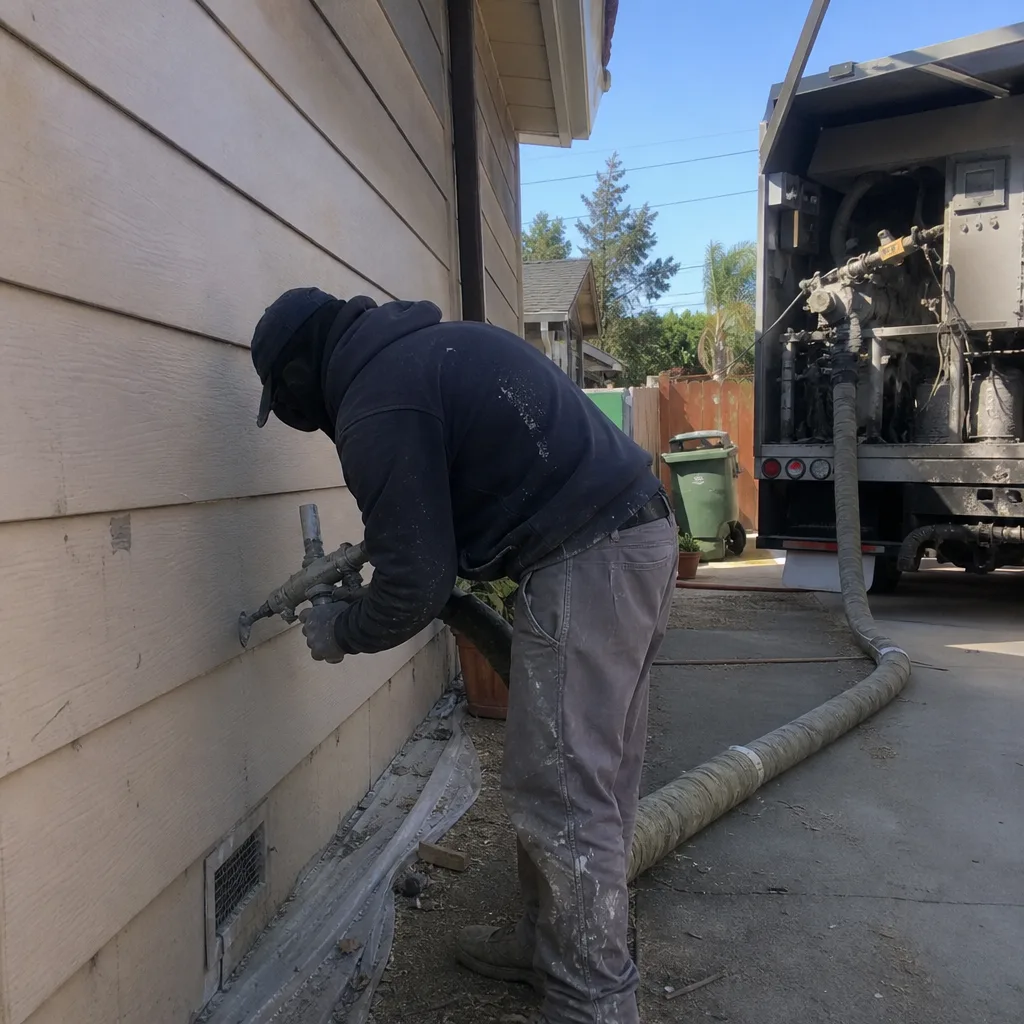
Last updated September 16, 2026
Insulation Permits, Codes & Inspections in CA: What You Need to Know
Adding insulation to an existing attic in California typically does not require a permit. But the moment you touch HVAC ducts or remove and replace existing insulation as part of a remodel, Title 24 compliance kicks in and the rules change entirely. What most Costa Mesa homeowners don’t realize is that the line between “simple upgrade” and “permitted alteration” is drawn by a handful of specific triggers buried in the California Energy Code, not by common sense. Get it wrong and you’re not just risking a fine. You’re potentially sitting on an unpermitted improvement that surfaces during escrow and costs thousands to resolve. This guide walks through exactly what requires a permit, what doesn’t, and how inspections actually work in Southern California, so you can move forward with confidence instead of anxiety.
Quick Answer
For most existing single-family homes in California, adding insulation to an attic or wall cavity is classified as a minor repair and does not require a building permit, provided no structural, electrical, or HVAC alterations are made. However, any insulation work tied to a remodel, addition, or HVAC duct replacement triggers Title 24 Part 6 energy code compliance, which may require a permit, a HERS rater verification, and a final inspection. The safest path: check with your city’s building department before starting, and if you work with a licensed contractor, make sure every job is code-documented whether or not a permit was formally required.
Table of Contents
- What Actually Triggers an Insulation Permit in California
- Title 24 Part 6 and What It Means for Costa Mesa Homes
- Minimum R-Values for Climate Zone 8 (Orange County)
- The HERS Rater Role: When Third-Party Verification Is Legally Required
- How Skipped Permits Surface During a Home Sale (And What It Costs)
- City-by-City Differences: Costa Mesa vs. Neighboring OC Municipalities
- How We Document Every Job for Resale Protection
- Common Mistakes to Avoid
- When to Call a Professional
- Frequently Asked Questions
What Actually Triggers an Insulation Permit in California
The California Building Standards Code (Title 24) draws a distinction between maintenance, repair, and alteration. Most insulation work falls into the repair category, which is explicitly exempt from permit requirements under the California Residential Code (CRC) Section R105.2. But the exemptions are narrower than most homeowners assume, and several adjacent conditions pull insulation work into permit territory.
Here’s the breakdown of what requires a permit and what doesn’t in a typical Costa Mesa single-family home:
- Blown-in or batt insulation added to an existing attic: No permit. This is classified as a minor repair or maintenance activity, similar to painting or flooring.
- Replacing like-for-like insulation (old fiberglass for new fiberglass): No permit, as long as no other system is touched.
- Spray foam applied to an existing attic or rim joist: No permit in most jurisdictions, though some cities require a simple notification if the foam is classified as an ignition barrier material. Costa Mesa does not currently require this.
- Insulation installed as part of a kitchen or bath remodel where walls are opened: Permit required. Once a building permit is issued for the remodel, the insulation work falls under that permit’s scope and must meet current Title 24 standards, not the standards from when the house was built.
- Replacing or relocating HVAC ducts while insulating: Permit required. Duct work is mechanical equipment under the California Mechanical Code. If your attic needs new ducting and insulation at the same time, the entire job becomes a permitted project.
- Converting an unconditioned space (garage, attic) into conditioned living space: Permit required. This is an alteration, not a repair, and triggers full energy code compliance including mandatory insulation levels.
- Removing and replacing insulation in a home built before 1977: Permit often required if the removal disturbs vermiculite or asbestos-containing materials. California law requires an asbestos survey for any material disturbance in pre-1977 construction.
We’ve helped hundreds of Costa Mesa homeowners navigate this exact question, from Mesa Verde ranchers to Eastside bungalows. The pattern we see is consistent: if the only thing changing is the insulation itself, no permit. If the insulation is part of a larger project, the permit umbrella covers everything.
Title 24 Part 6 and What It Means for Costa Mesa Homes
Title 24 Part 6 is California’s Energy Code, the strictest set of energy efficiency requirements in the United States. Since the 2022 update, every new construction project and remodel in the state must meet prescriptive or performance-based standards that cover insulation, air sealing, HVAC efficiency, lighting, and fenestration. The 2025 code cycle makes these standards even tighter, with an emphasis on electric-ready homes and heat pump adoption.
For Costa Mesa specifically, Title 24 matters in two distinct ways:
- Mandatory minimums for any permitted project. If you’re doing a permitted remodel, addition, or HVAC replacement, the insulation installed as part of that work must meet or exceed the prescriptive R-value requirements for climate zone 8. If it doesn’t, the project fails inspection, full stop. No exceptions for “the old stuff was fine.”
- Air sealing verification. Title 24 now requires blower door testing on many permitted projects to verify that air leakage meets the maximum allowable envelope leakage rate. Insulation alone won’t pass this test. You need actual air sealing at top plates, plumbing penetrations, recessed can lights, and attic hatches, among other spots. In our experience, Costa Mesa homes built in the 1960s and 1970s leak far more than the code allows, and the fix is almost always air sealing first, insulation second.
The practical takeaway: Title 24 isn’t just about R-values. It’s about the building envelope as a complete system. The code assumes that insulation and air sealing work together, and the compliance forms (CF-1R, CF-2R, CF-3R) require documentation of both. A homeowner who stuffs R-38 into an attic but skips air sealing will still fail a Title 24 inspection.
Minimum R-Values for Climate Zone 8 (Orange County)
Orange County falls under California climate zone 8, which has mild winters and warm, dry summers. Here’s what Title 24 Part 6 prescriptively requires for your climate zone.
Attic Insulation
- Prescriptive minimum: R-38 ceiling insulation in vented attics. In practical terms, that’s about 12 to 14 inches of blown-in fiberglass (Johns Manville or Knauf brands typically installed at R-3.2 to R-3.5 per inch) or roughly 10 to 11 inches of blown-in cellulose.
- Radiant barrier alternative: In climate zone 8, Title 24 allows a reduced insulation level of R-30 in the attic if a radiant barrier is installed on the underside of the roof deck. This tradeoff works well in Costa Mesa because our cooling degree days are significant, and a radiant barrier cuts attic heat gain substantially in the summer months.
Wall Insulation
- Prescriptive minimum for 2×4 framed walls: R-13 to R-15 depending on the assembly. Rockwool Comfortbatt R-15 is a common choice we install because it fits a 2×4 cavity properly and offers better thermal and acoustic performance than standard R-13 fiberglass.
- Prescriptive minimum for 2×6 framed walls: R-20 to R-21.
Floor and Crawl Space
- Raised floor minimum: R-19 under the floor joists. For Costa Mesa homes with vented crawl spaces, this is a common retrofit, and it should be paired with a Class I or Class II vapor barrier on the crawl space floor to meet code intent.
- Conditioned crawl space alternative: If you’re encapsulating your crawl space (lining the walls and ground, sealing vents, and conditioning the space), the insulation moves to the crawl space walls at R-19, not the floor. This is the approach we take on most Warmline Insulation Co. encapsulation projects in Costa Mesa because it creates a cleaner, drier space and meets code.
These numbers are the floor, not the ceiling. Many Costa Mesa homeowners choose to exceed them, especially in west-facing second-story bedrooms that bake in the afternoon sun. The code minimum keeps you compliant. It doesn’t guarantee comfort.
The HERS Rater Role: When Third-Party Verification Is Legally Required
A HERS rater (Home Energy Rating System) is an independent, state-certified professional who verifies that energy-efficiency features are installed correctly and perform as designed. HERS raters are not building inspectors. They don’t work for the city. They work for a HERS provider company, and they are legally required on specific California construction projects.
Here’s when a HERS rater is mandatory, and when they’re not:
Required: Any new construction single-family home or multi-family building of three stories or fewer. Any permitted alteration that changes the building’s envelope (walls, ceiling, floor) beyond minor repair. Any project where you’re claiming performance-based compliance (meaning you’re using the energy modeling approach rather than simply meeting each prescriptive value).
Not required: Insulation-only upgrades to an existing home where no permit is being pulled and no performance claim is being made. Simple like-for-like replacement. Attic insulation retrofits that fall under the repair exemption.
The HERS rater’s primary responsibilities during a permitted insulation project are:
- Field verification: Confirming the installed insulation matches the documented R-value on the CF-2R form.
- Quality of installation grading: Checking for gaps, voids, compression, and proper coverage. California requires a Grade I installation (essentially no defects) for fiberglass and cellulose in most compliance paths.
- Blower door testing: Verifying the whole-house air leakage number meets the code maximum. In climate zone 8, the typical target is 3 to 5 air changes per hour at 50 Pascals (ACH50), depending on the compliance approach.
- Duct leakage testing: If the project includes duct replacement or sealing, the rater tests total duct leakage with a Duct Blaster to confirm it’s below the code threshold.
In Costa Mesa, we see HERS involvement most often on whole-home remodels and additions, not on standalone insulation retrofits. But the documentation a HERS rater produces is valuable regardless. A current CF-2R and CF-3R with passing test results is gold when you sell. It tells a buyer’s inspector that the insulation wasn’t just thrown in, it was verified.
How Skipped Permits Surface During a Home Sale (And What It Costs)
The scenario plays out in Costa Mesa every month. A homeowner lists a charming 1960s ranch on the Eastside. Buyers make an offer. Escrow opens. The buyer’s home inspector climbs into the attic and sees fresh-looking insulation. The inspector notes it on the report: “Attic insulation appears recent. Recommend verifying permit status.” The buyer’s agent requests permit history from the city. Nothing on file.
Now what? The insulation itself might be perfectly fine. But it’s flagged as a potential unpermitted improvement, and the transaction gets complicated. Here’s what typically happens:
- The buyer requests a retrofit permit. The seller must now pull a permit after the fact, which means the work has to be verified to meet current code. If the insulation was under-installed or air sealing was never done, the retrofit becomes expensive to resolve.
- The seller offers a credit in lieu of permits. Buyers often ask for a price reduction of $5,000 to $15,000 to cover the perceived risk. In a competitive Costa Mesa market, sellers may resist, but the buyer has leverage once the issue is flagged.
- The deal falls apart. Some buyers walk entirely, especially on older homes where one unpermitted item suggests there may be others. The seller relists, and now the property has a disclosure history that must be shared with future buyers.
What does a retrofit permit cost? The permit fee itself is modest, typically $200 to $600 depending on the city. The expensive part is the verification work. If a HERS rater finds deficiencies, you’re paying to fix them under time pressure while the buyer waits. That’s rarely a good negotiating position.
City-by-City Differences: Costa Mesa vs. Neighboring OC Municipalities
California energy codes are statewide, but interpretation and enforcement vary by jurisdiction. Costa Mesa operates its own building department, as do most Orange County cities. Here’s a quick comparison of how the rules land in cities we serve regularly:
- Costa Mesa: The Building Division takes a practical, consistent approach. Insulation-only retrofits on existing homes don’t require permits. Remodels and additions do. The city’s inspectors are knowledgeable about Title 24, and plan check reviews are generally completed within one to two weeks for simple residential projects.
- Newport Beach: Similar process to Costa Mesa, but coastal overlay zones can add extra review time for anything touching the exterior envelope. Interior insulation work is unaffected.
- Huntington Beach: The city is particularly rigorous on HERS verification for permitted remodels. Expect a rater to be involved on any project where walls are opened.
- Irvine: Because much of the housing stock was built under Planned Community districts, some HOAs require architectural review for any exterior change, including visible attic vent alterations during insulation work. The permit rules themselves align with the state and county standard.
- Santa Ana: Older housing stock means more pre-1977 asbestos considerations. Santa Ana’s building department frequently asks for an asbestos survey when insulation removal is part of a permitted project in older homes.
If you’re in Costa Mesa and your contractor tells you a permit is “always” or “never” required, that’s a red flag either way. The correct answer depends on the scope, and a competent contractor will walk you through the specific triggers I outlined above before any work begins.
How We Document Every Job for Resale Protection
Permit or no permit, the goal is the same: when you sell your Costa Mesa home, the insulation work should never become a liability. We’ve thought about this from the buyer’s inspector’s perspective, and here’s the documentation package we build for every project, whether it’s a simple attic insulation upgrade in Costa Mesa or a full spray foam installation:
- Scope of work letter: A written description of exactly what was installed, where, and to what R-value. This tells a future inspector the project was done deliberately, not casually.
- Material verification: Brand names, product specs, and installation date. If you ever need to prove the insulation is Rockwool Comfortbatt R-15 rather than builder-grade fiberglass, you’ll have the invoice and the product data sheet.
- Photo documentation: Before, during, and after photos of the attic, wall cavities, or crawl space. This is the single most persuasive piece of evidence for a skeptical buyer’s agent.
- Code compliance statement: A written statement from us that the work meets or exceeds Title 24 Part 6 requirements for your climate zone, signed by Neil Ashford, Owner.
- Permit documentation (when applicable): If a permit was pulled, you receive a copy of the final inspection sign-off and any HERS rater reports.
We’ve had past clients call us years after an insulation job, in escrow, asking for documentation. We have it. That’s the point of operating this way from day one. The blown-in insulation work we do in Costa Mesa today should be defensible in 2035.
Common Mistakes to Avoid
- Assuming “no permit” means “no documentation.” Even exempt insulation work should be documented with photos, receipts, and a scope letter. When a buyer’s inspector asks, “You’ll want to have an answer.”
- Touching HVAC ducts during an insulation upgrade. In Costa Mesa attics, ductwork and insulation are often tangled together. If your contractor moves, cuts, or re-routes ducts to access an area, the job now triggers mechanical permit requirements. Make sure the scope is clear before work begins.
- Compressing fiberglass batts to fit a cavity. R-30 batts jammed into a 2×4 wall perform like R-19 or worse, and a HERS rater will fail the installation. Compression is the most common quality defect we correct on other contractors’ work in Costa Mesa.
- Removing old insulation without checking for asbestos. Pre-1977 homes in Costa Mesa are common. Vermiculite from Libby, Montana was used in attics throughout Orange County, and disturbing it without testing is a health risk and a legal liability.
- Skipping air sealing and calling it “insulation.” Title 24 treats them as a system. A permit-triggering remodel requires both, and a standalone attic retrofit without air sealing leaves most of the comfort benefit on the table.
- Using a contractor who won’t show proof of license and insurance. In California, anyone performing work over $500 must hold a C-2 insulation and acoustical contractor license. Ask to see it. Ask to see the insurance certificate too.
- Waiting until escrow to resolve permit questions. Retrofit permits are faster and cheaper when there’s no buyer applying pressure. If you know you have unpermitted insulation work from a previous owner, resolve it before you list.
When to Call a Professional
Insulation is one of those trades that looks simple and isn’t. You need to know the code, the climate zone requirements, the material behavior, and the documentation trail. You need to understand how the attic ventilation system interacts with the insulation you’re adding. You need to know when a vapor barrier helps and when it causes mold in a Costa Mesa coastal home. If you’re unsure about any of these, or if your project touches ducts, walls, or a pre-1977 home, call a licensed contractor before you touch anything. Warmline Insulation Co. offers free estimates in Costa Mesa. Call (657) 224-2897 and you’ll speak with a live person, not a voicemail, 24/7. We’ll walk the property, answer your permit questions honestly, and tell you exactly what the project requires.
Frequently Asked Questions
In most cases, no. Adding insulation to an existing attic in a Costa Mesa single-family home is classified as a minor repair under California Residential Code R105.2 and does not require a building permit, provided no structural, electrical, or HVAC modifications are part of the work. If you’re planning to also replace ducts, open walls, or convert the attic into living space, a permit is required. Call (657) 224-2897 for a straight answer about your specific house.
For new construction and permitted remodels in climate zone 8 (which includes Costa Mesa and all of Orange County), California Title 24 requires R-38 ceiling insulation in vented attics, or R-30 with a radiant barrier installed under the roof deck. For existing homes doing an insulation-only retrofit, the state doesn’t force an upgrade to R-38, but it’s the smart standard to target, and exceeding it is often the right call in west-facing Costa Mesa homes.
Spray foam insulation follows the same repair-versus-alteration logic as other insulation types. An insulation-only spray foam retrofit in an existing Costa Mesa home typically doesn’t require a permit. However, some California jurisdictions require a notice filed with the building department when spray foam is applied as an ignition barrier material, and spray foam used in a permitted remodel falls under that project’s Title 24 compliance requirements. We’ll handle any notification requirements for you.
The work will likely be flagged during the buyer’s home inspection, and you’ll face one of three outcomes: a retrofit permit requiring verification to current code, a price concession to the buyer, or a lost sale. Resolving the permit question proactively before listing is faster and cheaper than negotiating under escrow pressure. If you’re not sure of the status of your existing insulation, call (657) 224-2897 and we’ll assess it during a free estimate.
A HERS rater inspection for a typical insulation and air sealing project in Orange County runs $350 to $700, depending on the size of the home and the number of tests required. This doesn’t include the cost of fixing any deficiencies the rater identifies. For simple retrofit projects where no permit is required, a HERS rater isn’t mandatory, but we recommend at least a documented visual verification for resale protection.
Yes. When a permit is required for your project, we handle the plan submittal, coordinate the HERS rater, schedule inspections, and deliver the final sign-off to you. When a permit isn’t required, we still provide the documentation package described above so your insulation work never becomes a question mark during a home sale. Call (657) 224-2897 any time, day or night, and a live person will help.
The Bottom Line
California’s Title 24 energy code is strict, but it’s also logical. The line between permitted and permit-exempt insulation work falls on a few clear triggers: are you altering structure? Are you touching HVAC? Are you converting unconditioned space? If the answer is no, your attic retrofit in Costa Mesa almost certainly doesn’t need a permit, but you should still build a documentation trail for the day you sell. If the answer is yes, meet the code head-on, use a HERS rater where required, and keep every piece of paper. Most of the pain we see comes not from the code itself but from homeowners and contractors who ignored it or misunderstood the triggers. Understand those triggers, and the process becomes straightforward.
Written by Neil Ashford, Owner at Warmline Insulation Co., serving Costa Mesa since 2011.